This year OpenRules will again be an exhibitor at the Business Rules and Decisions Forum 2016 at BBC conference on Oct 31- Nov 4, 2016, Las Vegas, NV. We are sponsoring this major BR&DM event for 13 years in a row. I’ve just received a confirmation that my presentation“Why” and “What-If” Buttons for Business Decision Management” has been accepted. Here is an abstract: Continue reading
Business Rules and Tacit Knowledge
Listening several recent presentations of Pragmatic Dave Thomas (see this and this), I cannot help getting back to the fundamental decision modeling problem: Rules vs. Tacit Knowledge (or Intuition). Continue reading
After bpmNEXT-2016
Today was the last day of bpmNext-2016 – a great event concentrated around 3 closely related technologies and their standards: BPMN, CMMN, and DMN. You may look at the program to see how many well-known experts and vendors attended the conference. The quality of presentations and informal discussions during and after the sessions was something that we all will remember after this event. Continue reading
Decision Models: Finding Alternative and Optimal Decisions
People frequently assume that a good, consistent decision model should produce one and only one decision (solution) for any valid input. However, in real-world applications we frequently deal with situations when a decision model may produce multiple feasible solutions for the same input. And it does not mean that the decision model is incomplete – simply a user may choose the most appropriate solution among all produced decisions. It can be done interactively or by adding more rules. I’ve already provided an example “Monkey Business Analyzed” that describes how to deal with multiple decisions using OpenRules What-If Analyzer. In this post I will describe another decision model that also shows how to choose an optimal decision among multiple feasible decisions. Continue reading
RuleML and DecisionCAMP 2016
This year OpenRules will sponsor the 10th International Web Rule Symposium RuleML that will take place at the Stony Brook University, New York on July 6-9, 2016. RuleML is well-known for building bridges between academia and industry in the field of business rules. Our CTO Dr. Jacob Feldman is a publicity chair of the conference. He is also the organizer of DecisionCAMP-2016 that will be held on July 7-8 at RuleML. This year DecisionCAMP will focus on the new OMG standard “Decision Model and Notation (DMN)” and an emerging best practice. If you attend, you will have a chance to meet face-to-face with many well-known decision management gurus, vendors, and practitioners.
“Monkey Business” Analyzed
I decided to add the decision model “Monkey Business” to our new What-If Analyzer. It brought several considerations missed by other solutions. In this post I will discuss my implementation and will show how What-If Analyzer helps to do a through analysis of usually unnoticed aspects of business decision modeling. Continue reading
bpmNEXT 2016
This year OpenRules will participate in the bpmNEXT 2016 that will take place at Santa Barbara, CA on April 19-21, 2016. This is a very selective conference that does not allow marketing and forces the presenters to do only live demonstrations of specific achievements that have a chance to shape the next generation of Business Process Management software – including intelligent operations, the Internet of Things, case management, business decision management, and goal-directed processes. I will present “Dynamic Decision Models: Activation/Deactivation of Business Rules in Real Time” on Apr. 21 at 14:00. Continue reading
Decision Model for Vacation Days Calculation
This month DMCommunity.org asked to present the best design of the notorious decision tables offered by Prof. Jan Vanthienen. It should implement the following business logic: Continue reading
OpenRules 6.3.4 Introduces What-If Analyzer of Decision Models
On December 28, 2015 we published a new OpenRules release 6.3.4 that introduces What-If Analyzer, the first tool of this type in the Decision Management domain. Its main purpose is to support what-if analysis of decision models built in accordance with the DMN standard. What-if analysis is the process of changing the business rules that represent business logic to see how those changes will affect the outcome of the decision model. Here is the main view of the What-If Analyzer for the decision model “Make a Good Burger” offered by the DMCommunity.org: Continue reading
Automatically Learned Business Rules: Should We Understand Them?
Question: Should we worry that we’re building systems whose increasingly accurate decisions are based on incomprehensible foundations?
I’ve just posted an article with the same name at the LinkedIn Pulse that addresses this question. It is especially important in the context of rules-based decision making when rules that govern our decisions have been automatically generated using predictive analytics techniques. I shared two examples from OpenRules experience that explain why the automatically generated business rules should be comprehensible. The first one talks about the use of our Rule Learner at IRS. The second example deals with our Rule Compressor.
OpenRules at BBC-2015
Since its incorporation in 2003, every year OpenRules, Inc. attends, sponsors, and presents at the Business Rules Forums. This year OpenRules will again be a sponsor and a presenter at this largest Business Rules and Decision Management event now called BBC-2015 that will be held in Las Vegas on November 2-6, 2015. Continue reading
“Old” and “New” Business Rules Approaches
The recent LinkedIn discussion “What rules representation to choose for which audience?” came to the question about business analysts handing their business rules written in plain English over to IT for an implementation. Continue reading
Identification of the Executed Rules
Our customers often want to identify the actually executed rules. By default they may look at the automatically generated execution reports in the HTML format Continue reading
Predictive Analytics is Becoming Mainstream
“Big Data” have brought “Predictive Analytics” (long-time available but hidden in the academic world under the names “Machine Learning” and “Data Mining”) to the spotlight of the modern Business Analytics. These days you will find many examples when analytics enables business decisions by supporting a path from data to decisions and actions. Below I will briefly talk about nowadays positioning of the Business Analytics and more about OpenRules own experience in this area including OpenRules Rule Learner. Continue reading
Don’t Program a System, Educate It!
Modern decision management techniques enable business decisions by supporting a path from data to decisions and actions. Wherever people use stand-alone Business Rules, Complex Event Processing, Predictive Analytics, Optimization systems or their combinations, they prefer to put in charge subject matter experts and not software developers. Actually, all these systems tend to be declarative and allow customers to feed their systems with externally maintained business knowledge, e.g. historical data and/or already known business rules. Nowadays people in a way want to educate a general purpose system with their domain-specific knowledge avoiding traditional programming. Continue reading
OpenRules Dialog Questions in Multiple Tables
If you have too many questions in your OpenRules Dialog project, you may want to split a large table “questions” into several tables. Continue reading
OpenRules Business Glossary in Multiple Tables
By default OpenRules provides a glossary template that allows our customers to create their own business glossary in one table. Below I will explain how to split a glossary between multiple tables. Continue reading
Presentation at BBC-2015: Good Old UServ Product Derby in the Brave New World of Decision Management
James Taylor and I are giving a session at this year’s Building Business Capability conference on “Good Old UServ Product Derby in the Brave New World of Decision Management“at 4:50pm on the Wednesday of the show. Continue reading
Decision “Make a Good Burger”
DMCommunity.org published an interesting June-2015 Challenge called “Make a Good Burger“. Below I describe an OpenRules-based decision model that provides various solutions for this problem. Continue reading
DMN 1.1 Issues: Aggregation
DMN defines “aggregation” in the following way:
“Multiple hits must be aggregated into a single result. DMN 1.0 specifies six aggregation indicators, namely: collect, sum, min, max, average. Optionally, the aggregation indicator may be included in the table. The default is collect.”
Below is a list of my issues with this DMN 1.0 approach. Continue reading
DMN 1.1 Issues: Multi-Hit Decision Tables
In an ideal world we would limit ourselves to Single-Hit decision tables that cover all possible combinations of the involved decision variables. However, DMN rightfully introduced so called “multiple hit” (or “multi-hit”) decision tables to stay closer to the decision modeling reality. Continue reading
Enhanced Live Catalogs at DMCommunity.org
A few years ago, I wrote a web application that allowed professional communities to support Live Catalogs of different software tools. The “live” means that a product catalog is automatically updated whenever the profiles of products included into the catalog are added or updated by their authors. Continue reading
Decision Model “Vehicle Insurance – UServ Product Derby”
As a response to the DMCommunity.org challenge, I will describe an OpenRules-based implementation of the highly popular use case known as “UServ Product Derby”. The use case deals with automobile insurance problems including eligibility and pricing decisions for a hypothetical insurance company “UServ”. Its detailed description can be found here. Our implementation may be considered as another complex-enough example of the DMN approach. Continue reading
Decision “Determine a Killer of Aunt Agatha”
Could we use decision tables to represent and solve complex logical problems? An example of such problem was offered by the DMCommunity.org in the Nov-2014 Challenge called “Who Killed Agatha“. Continue reading
Resolving Conflicts among Business Rules
Contradictory business rules occur in normal business situations, and maintaining rules with exceptions is a very typical example of rule conflicts. Is it possible to automatically resolve such conflicts? Continue reading
Decisions with Mitigation Criteria
The Decision Management Community (http://DMCommunity.org) published an interesting Challenge in Oct-2014. It deals with a quite typical problem when some business rules may be mitigated by other rules. Here is an OpenRules-based solution that follows the DMN guidelines. The main idea is to use multi-hit decision tables when more specific rules (mitigations) may override more generic rules. Continue reading
A Little Story From OpenRules Trenches
I’d like to share a little story from our recent consulting experience. Being in the midst of helping our client to deliver a large OpenRules-based banking system, we received an urgent request. The problem should be familiar to many businesses who deal with NAICS (the North American Industry Classification System). Continue reading
OpenRules at 2014 Fall Conferences
This fall as usual OpenRules will participate in two major Business Rules and Decision Management events: DecisionCAMP-2014 and BBC-2014. DecisionCAMP is much smaller but more technical to compare with BBC that is now mainly oriented to business analysts. Continue reading
OpenRules Test Harness
A new OpenRules Release 6.3.1 enhances its Test Harness with automatic comparison of expected and actual decision execution results. Continue reading
Learning Business Rules from Data at RuleML-2014
This year RuleML-2014 will be held in Prague on Aug 18-20. For the first time it will include a special track called “Learning Business Rules from Data”. As a member of the organizing committee, I posted the proper announcement here. It promises to become a very interesting event when the decision management practitioners meet their academic partners. Continue reading
OpenRules Sandbox
To simplify an evaluation of the OpenRules BDMS we’ve created an OpenRules Sandbox – see http://openrules.com/sandbox.htm. So, you do not have to download or install any software to be able to run your own decision models. Continue reading
Can a Decision Model Define Uniqueness of Objects inside a Collection?
This question was asked by Antonio Plais – see the LinkedIn discussion. Several practical variations of this question were mentioned: 1) Define if the same product appears more than once in the same sales order; 2) determine the uniqueness of records in a file to be loaded into a Data Warehouse. Obviously, the question deals with business rules defined on collections of objects – not the most popular topic among decision modelers. Continue reading
Using Macros inside OpenRules Expressions
A new OpenRules Release 6.3.0 introduced “macro” to simplify an access to decision variables. For example, you may write a formula like below

Another DMN Decision Model (executable!)
Today Nick Broom published his own example of a decision model based on his understanding of the current version of the DMN standard. Nick is a business analyst and a well-known decision management practitioner, so his interpretation is very valuable as the standard is oriented to the business analysts (not to programmers). Nick’s example is supposed to make a decision whether an applicant is eligible or ineligible to a credit card. Nick described a simple credit card application process and designed decision requirements diagrams and related decision tables.
Starting to read his post, I decided that it could be helpful to make Nick’s decision model executable and to test if it actually produces the expected results. It took me several hours to do it using mainly Excel and the latest version of OpenRules BDMS. Continue reading
My LinkedIn Discussions
LinkedIn today is probably the most popular social network for professionals. Looking for one of my old posts, I noticed that it is not so simple to find it and many people have troubles to do it. However, when you click on your name inside any discussion you will receive links to everything you posted but only within one discussion group. Here are LinkedIn discussions that I’ve started in several groups: Continue reading
2013 => 2014
2013 was a year when OpenRules became 10 years old. These days it is a mature BR&D (Business Rules and Decision) Management product used by thousands of customers worldwide. The following statistic from http://openrules.com demonstrates the constantly growing popularity of our product: Continue reading
API for Generation of OpenRules Decision Tables in Excel
With a new release 6.2.6 of OpenRules® you may generate Excel files with multiple decision tables using a simple Java API. It includes class DecisionBook that corresponds to one Excel workbook (an xls-file), to which you may add multiple OpenRules® decision tables. Continue reading
Live Catalogues of Decision Management Tools
Today I am pleased to announce availability of the new Decision Management Community website called www.decision-tools.org. What is it all about? Continue reading
OpenRules at Decision CAMP 2013
OpenRules is one of the initiators and sponsors of the DecisionCAMP-2013, the
first event for Decision Management practitioners, which will be held in San Jose, CA on Nov 4-6. This event attracted many well-known experts in the business rules and decisions management area – see the agenda. We expect ~250 attendees. OpenRules will participate in the following mini-events: Continue reading
OpenRules in Japan
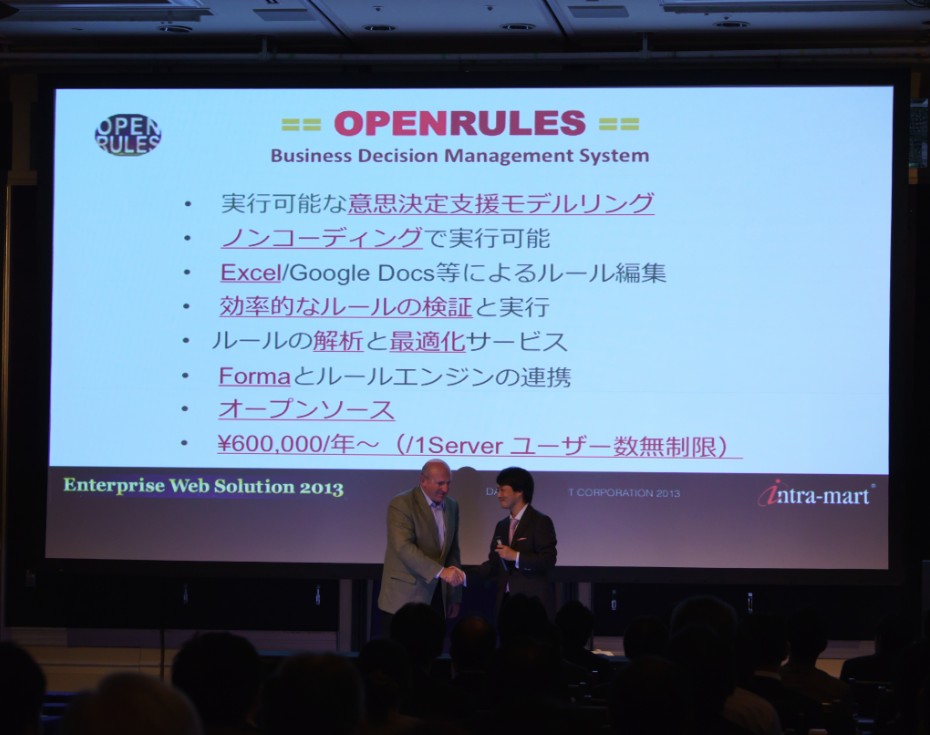
Dr. Feldman and Mr. Nakayama, CEO at Intra-Mart
I’ve just returned from my first ever trip to Japan. I am coming back home to the US with very bright impressions of the Japanese culture and people. I was especially impressed by the deep respect and high professionalism with which people in Japan perform their jobs independently of how small or important those jobs are. I deeply appreciate the friendliness and readiness to help from people on the streets of Tokyo and Kyoto that I have not seen for a while.
This visit was organized by our Japanese partner NTT Data Intra-Mart. Continue reading
Solving Rule Conflicts – Part 2
“The Sleep of Reason Produces Monsters”, Francisco Goya
Defeasible Logic and Business Rules with Probabilities
Modern rules and decisions management systems provide effective mechanisms for development of good decision models. However, building real-world decision models people always face complex issues related to diagnostic and resolution of rule conflicts. Some systems can effectively verify decision model consistency and diagnose rule conflicts. But there are no practically used Business Rules (BR) products that claim that they may automatically resolve rule conflicts.
In the Part 1 of this series I described how end users can represent their rules in single-hit and multi-hit decision tables while avoiding rule conflicts. But is it possible to automatically resolve rule conflicts? I will discuss this problem below. Continue reading
Solving Rule Conflicts – Part 1
Representing Contradictory Rules with Single-Hit and Multi-Hit Decision Tables
Modern rules and decisions management systems provide effective mechanisms for development of good decision models. However, building real-world decision models people always face complex issues related to diagnostic and resolution of rule conflicts. Some systems can effectively verify decision model consistency and diagnose rule conflicts. But there are no practically used Business Rules products that claim that they may automatically resolve rule conflicts (at least I am not aware of them). As a result, it becomes a responsibility of users to represent rules in such a way that allows them to avoid conflicts. Continue reading
Upcoming Events
This fall there will be several international events related to Decision Management: Continue reading
Building a Maintainable Product Catalogue with OpenRules Dialog
This year I will chair a workshop “CPSOLVERS-2013” at the major Constraint Programming conference “CP 2013“. Preparing the workshop, we’ve decided to create an industrial overview of all supported constraint solvers currently available to business application developers. Continue reading
Webinar: Creating and Managing Executable Decision Models with DecisionsFirst Modeler and OpenRules
Watch Recorded Webinar
We are pleased to announce a joint free webinar organized by Decision Management Solutions and OpenRules.
Converting Decision Tables from PDF to OpenRules
There is a free tool called “pdftoexcel” that allows you to convert tables from a PDF format to Excel. This tool can safe you a lot of retyping if you have many rules tables in PDF and want to convert them to Excel-based OpenRules decision tables. Continue reading
Determine the Risk of Meeting a Werewolf
Today there was a post at the LinkedIn group “Looking for a simple example of representing calculations in a Decision Model” with this problem description: Continue reading
Combining Constraint Solving with Business Rules and Machine Learning – CoCoMiLe 2013
The integration of different decision making techniques finally is finding its home under the roof of the Decision Management movement. I am glad that an integrated Constraint Programming (CP), Business Rules (BR), and Machine Learning (ML) approach is gaining in popularity as well. An interesting workshop “CoCoMiLe 2013 – Continue reading
Rule Violations and Over-Constrained Problems
“Learn the rules like a pro, so you can break them like an artist.” – Pablo Picasso
Practical people know that one of the most important property of a business rule is its ability to be violated. Here are a few examples:
Decision Execution Reports
OpenRules Release 6.2.3 adds an ability to generate decision execution reports in the HTML format. These reports help a rule designer to analyze which rules were actually executed and in which order. Continue reading
 OpenRules - Decision Intelligence Platform