Contact ustinovich@openrules.com to make a purchase.
DecisionCAMP 2026
A new 2026 is around the corner. We’ve just published a new website for DecisionCAMP-2026. This is a major annual event devoted to Decision Intelligence Technologies. It is scheduled to take place online from August 26 to 28, 2026. It is organized by the Decision Management Community and will take place concurrently with the Declarative AI 2026 conference. The Registration is FREE. Call for Presentations is open – you may submit your abstract via EasyChair. Contact us if you plan to present and have any questions.

Decision Model Tolerance

Today, Adam DeJans Jr. wrote: “Every business operates with tolerance: delivery delays, budget overruns, staffing gaps. Good models price those instead of eliminating them.” Two weeks ago, I posted the related article “Decision Model Tolerance” on LinkedIn.
One More Time About Declarativity
Most experts and practitioners had agreed long ago that decision models should be declarative, meaning a user specifies WHAT the decision problem is and provides test cases with the desired outcome, and then the underlying decision engine or system automatically determines HOW to find the solution. Rule Engines and Constraint Solvers were specifically designed to support the declarativity.
Continue readingSolutions for Oct-2025 Challenge
DMCommunity has already received five solutions for its Oct-2025 Challenge “Decision with two objectives” which is looking for decision models that help a web designer to select certain features while satisfying budget and value constraints. It is quite a simple problem for most linear or constraint solvers, so it is no wonder that the first 3 solutions utilized different solvers: Seeker, Pymoo, and OPL CPLEX. What makes this problem more interesting is that it involves two conflicting objectives: total value and total cost. Our decision models are supposed to devise a rational way to trade them against each other.
Continue readingFinding decisions for complex problems with multiple interdependent sub-problems
After I wrote about “Making Operational Repetitive Decisions Under Uncertainty,” I found several interesting descriptions of how optimization experts, Adam DeJans Jr. and Helmut Simonis, deal with challenging issues arising in dynamic, real-world settings characterized by high levels of uncertainty. In this LinkedIn post, I quoted their thoughts, including concrete problem examples. Link
Making Operational Repetitive Decisions Under Uncertainty
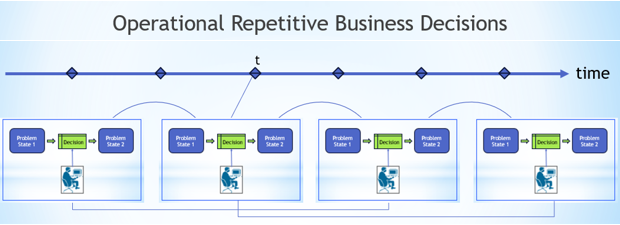
While just completed DecisionCAMP-2025 was dominated by the integrated use of Generative AI (LLMs) and Symbolic AI (Rules, Machine Learning, Optimization), in my closing notes I concentrated on the topic of making repetitive operational decisions in the real-world, frequently uncertain environments. In this article, I elaborated why it is important now and will be more important as the AI hype pushes our decision-making systems to even wider use within real-world business processes. Link
DecisionCAMP-2025
Last week’s DecisionCAMP-2025 became a chapter in the history of the Decision Intelligence movement. You can view all presentation slides and watch all recordings from the Program or directly on the YouTube Channel. Here are my Closing Remarks.
Advanced Rule Learner: Building Decision Models from Examples
Today, four days before the start of DecisionCAMP-2025, we announced the public availability of the Advanced Rules Learner, a Machine Learning (ML) product designed for business users and well-integrated into the OpenRules Decision Intelligence Platform. Now it can generate working decision models based only on a set of problem examples. I will demo the latest capabilities during my presentation at DecisionCAMP on Sep 22 at noon EDT. You may preview my slides ahead of time. Why did we decide to enhance Rule Learner?
Continue readingWhy Decision Optimization Remains Underutilized
Adam DeJans just posted: “Most people don’t realize how much of the world runs on a math method called Mixed-Integer Linear Programming (MILP). It is how airlines schedule flights, supply chains allocate products, and manufacturers decide what to make.” https://lnkd.in/e_WAHxYc
He is right. Still, despite their proven effectiveness in real-world decision-making systems, optimization solvers—such as Constraint Programming (CP), Linear Programming (LP), and Mixed-Integer Programming (MIP)—remain underutilized by many decision intelligence practitioners. One contributing factor is the perception that these tools require experts like Adam DeJans to apply optimization effectively.
Business Rules with Regular Expressions
Almost all programming languages support regular expressions. Many search languages allowed simple wildcards, for example “*” to match any sequence of characters, and “?” to match a single character. Non-programmers may use regular expressions in many situations just as well. In particular, business rules may need to define conditions that use regular expressions. Examples of such rules were specified in the DMCommunity July-2025 Challenge. Below is a possible OpenRules solution.
Continue readingOpenRules Release 11.0.0 is publicly available
The new release 11.0.0 of the OpenRules Decision Intelligence Platform (http://OpenRules.com) simplifies the installation process, and the standard installation now includes various OpenRules samples and documentation. We also introduced advanced features to Rule Learner, Rule Solver, and Rule DB. The website OpenRules.com has been unified and now includes product-specific sidebars.
Solving Challenge “Risky Stocks”
In this post, I describe a solution to the DMCommunity May 2025 Challenge and briefly analyze different approaches to rules with exceptions and conflicts.
Continue readingFrom Low-Code to No-Code to No-Logic?
Low-code/no-code approaches aimed to accelerate development and empower non-developers to create applications. Nowadays, GenAI automates code generation based only on the problem description in plain English. Do these approaches tend to hide and even remove the application logic along with developers? Read more
Resolving Conflicts among Business Rules
Ron Ross again brought up the question of “Exceptions to Business Rules”. Ron defines an exception to the rules as a foreseen, explicit set of circumstances in which different-than-normal guidance is to be followed. He gave an example: seeing-eye dogs as an (explicit) exception to dogs not being allowed in a hospital. One comment says: “I heard that there are no exceptions to the BRs. I heard that there are only other BRs.”
This discussion is still as important as it was years ago when we, vendors of Business Rules systems, considered it as a more generic problem of Resolving Conflicts among Business Rules.
Trying to find an optimal decision without an optimization engine
All provided solutions to the DMCommunity April 2025 Challenge “Case Assignment” use an optimization engine. The OpenRules solution utilized Rule Solver. I decided to try to solve this problem using only rules without any optimization engine. In doing that, my solution failed to satisfy all problem requirements. I believe it could be helpful for Business Rules practitioners to analyze (and potentially improve) my implementation described below.
Continue readingAssigning Cases to Analysts
DMCommunity.org published the April 2025 Challenge “Case Assignment”. Here is an OpenRules solution. First, we created a pure business decision model that defined all feasible case-analyst assignments. However, to find a solution that minimizes the total overqualification, we need to use an optimization engine. As usual with OpenRules, we prefer not just to solve the challenge but to build a working decision service that works for different datasets and is available from any remote cloud. The implementation based on Rule Solver is described below.
Continue readingNew book “Business Decision Modeling with OpenRules”
The new book is now available at Amazon: https://lnkd.in/ef-ygpJg. This book is oriented to subject matter experts who want to build operational decision models for their business environments. No programming skills are required. The objective is to help readers learn quickly how to apply the decision modeling approach to building real-world decision models. This book will guide readers through practical examples, starting with simple business problems and moving to complex ones. After learning how to create decision models, readers may also test, debug, modify, and analyze them using freely downloadable OpenRules software and familiar tools such as Microsoft Excel (http://OpenRules.com).
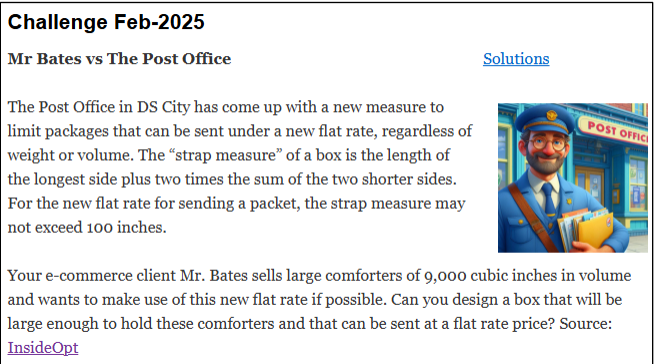
Continue readingOpenRules Solution to Feb-2025 Challenge “Mr Bates vs The Post Office”
DMCommunity.org posted the challenge “Mr Bates vs The Post Office”. I applied Rule Solver to demonstrate how to solve this challenge using several decision tables. Link
Then I decided to ask GenAI to produce a solution for this challenge using JavaSolver API. I was a bit surprised that Copilot is quite familiar with JavaSolver It quickly generated for me a Java program for a simple Arithmetic problem similar to this one. Then I gave the text of this Challenge in plain English, and Copilot generated a very good working solution for this challenge as well! Here it is: https://dmcommunity.org/wp-content/uploads/2025/03/challenge2025feb.copilot.pdf
Discovering Rules From Examples
Watch this short Richard Feynman’s video about Discovering Rules of Chess. He used a chess analogy to explain what we are doing in trying to understand nature: “Imagine that the gods are playing some great game like chess. You don’t know the rules of the game, but you are allowed to look at the board at least from time to time from a little corner, perhaps. And from these observations, you try to figure out what the rules of the game are, what are the rules of pieces moving.”
After watching this video, I decided it could be interesting today to refresh several past projects devoted to the Automatic Rules Discovery based on positive and negative examples. I will describe a few projects in which I and/or some of my colleagues were involved.
Continue readingOpenRules and SharePoint Integration
OpenRules announced a new Release 10.5.0 that integrates its Decision Intelligence Platform with Microsoft SharePoint. This development came in response to our large corporate customers who already use SharePoint as their major collaboration and document management platform to store, organize, share, and access information securely.
Why is this development important? For two reasons:
- OpenRules users can utilize SharePoint to manage their Rule Repositories
- SharePoint users can utilize OpenRules as a full-scale Decision Intelligence Platform.
In this post, I will explain both the benefits and how to integrate OpenRules and SharePoint.
Continue readingOpenRules Presentations and Publications
We’ve updated the list of publications and presentations that demonstrate the practical use of Decision Intelligence software including OpenRules Rule Engine, Rule Learner, and Rule Solver. It contains about 100 items with the latest being shown first. Link
Decision-Making Systems: Continuing Education
It is interesting to look at the latest Decision Intelligence trends from a 10-year-old perspective when GenAI was not even around. “You don’t program a system, you educate it. Rather than coding into the system, you merely provide a large set of training examples,” – wrote Jean-Francois Puget at that time. Reread my 2015’s post “Don’t Program a System, Educate It!“
AI for Decisions: a look from 2017 and today
After listening to the latest talk of Prof. Bob Kowalski on What is AI?, I remembered his talk about logical AI at the joint session of DecisionCAMP and RuleML+RR in 2017 in London. It also reminded my own prediction about “What is the next “killer” application for Decision Management?” at that time. Here is what I wrote about a Decision Reasoner in 2017:
Continue readingFuturistic Poetry and ChatGPT
I wondered how an LLM would interpret questions from some famous but hardly meaningful poetry. My first thought was “Could you play a nocturne on the flute of drainpipes?” (“А вы ноктюрн сыграть могли бы на флейте водосточных труб?”). It is from the 1913 futuristic verse by Mayakovsky.
Continue readingHappy 2025!

OpenRules team wishes a very Happy New Year to all our customers, colleagues, and families!
Happy Decision Modeling and DecisionCAMPing in 2025!
Christmas Word Search
DMCommunity.org offered a relatively simple challenge “Christmas Word Search” for holidays. My first inclination was to ask an LLM to solve it. I certainly was impressed that Copilot (or another LLM-based tool) could quickly build a code to find a correct solution. But then I thought: “Can I, a human, do better than LLM preferably without coding?” Below I describe my experiments from this morning.
Continue readingIntelligent Perpetually Running Decision Services
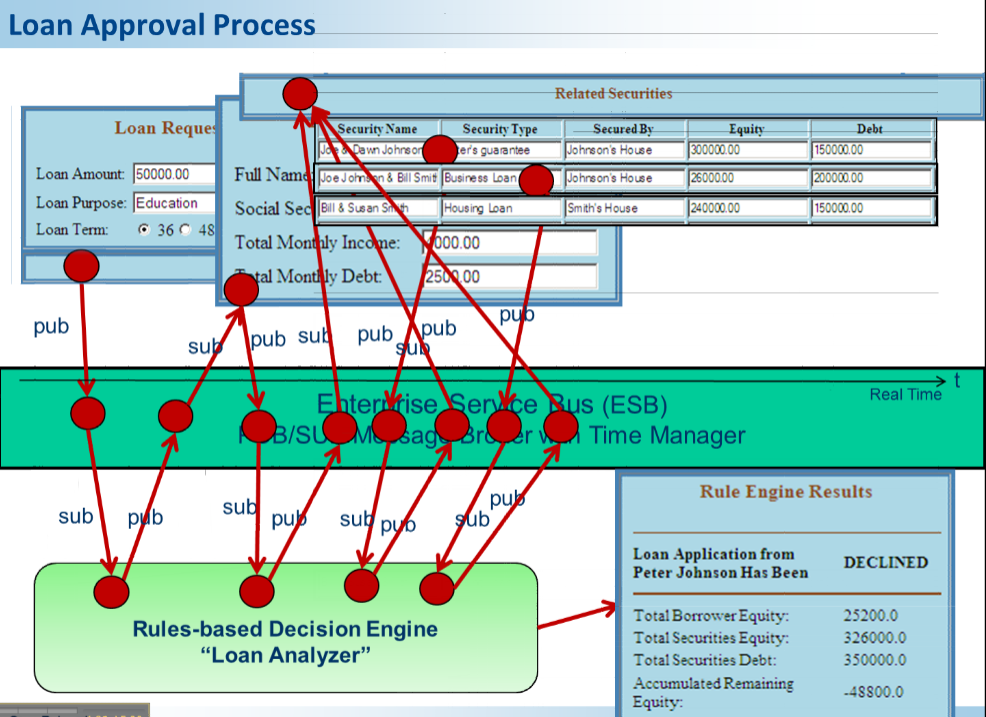
Today ResearchGate confirmed that people continue to read my 2019 presentation “Creating Intelligent Perpetually Running Applications with Business Rules” at the BBC conference. I reread its abstract: “In the AI era, many business applications which consider themselves “intelligent” cannot simply execute a complex rules-based transaction and wait for the next one. To become really “intelligent” applications, they should be able to learn from already executed transactions, accept new facts as they become available, and, when necessary, they should make changes in their own execution logic. This presentation describes a practical architecture that supports the creation and continuing development of such intelligent, perpetually running decision-making applications. This proposed architecture utilizes the modern pub/sub tools with continuous data streams and state machines, allowing subject matter experts to define and maintain behavioral and decisioning rules. It’s been demonstrated by using several real-world scenarios.” Then I went through my presentation with a new interest. If you are also interested in long-running decision services you may read about Stateful Loan Approval and watch Demo of a long-running decision service.
Movie Production Scheduler
This year OpenRules was approached by a film production company that wanted to optimize their movie production scheduling process. They wanted us to build a scheduler that receives the following input: multiple scenes, estimated time to prep and film the scenes, shooting locations, day and night shifts, all characters, cast members with their availability and associated costs, production units, and other related information. The objective of the scheduler is to schedule a production process over a certain period subject to time constraints, actor preferences, location availability, union requirements, and various soft and hard constraints. We’ve successfully and quickly developed a working prototype that satisfied major customer’s requirements and produced good schedules for this particular client. Then we expanded this development to a generic Movie Production Scheduler now available for solving similar scheduling problems with more custom constraints and preferences.
Continue readingIntegrating Rule Engine and Constraint Solver
OpenRules Rule Solver is an open-source tool that adds the power of Constraint and Linear Programming to Business Decision Modeling. It extends OpenRules Decision Manager to support Declarative Decision Modeling and Decision Optimization.
You may look at multiple decision models from Simple Arithmetic Problems to Smart Investments to see how Rule Solver helps define business optimization problems and produce their optimal solutions. One such decision model was created by our intern to ponder the DMCommunlity Challenge “Rental Boats“.
Continue readingGlossary and JSON Interface
Being at the heart of any decision model, OpenRules Glossary uses mandatory columns “Variable Name”, “Business Concept”, “Attribute”, and “Type” to define all used decision variables. It also may include many optional columns such as “Description”, “Used As”, and “Default Value” that allow you to effectively control the input and output of the decision model [read more]. The new OpenRules Release 10.4.1 adds new features to the Glossary that allow our customers to build more flexible JSON interfaces for OpenRules Decision Services.
Continue readingOpenRules Training/Consulting
In October-November of this year, OpenRules successfully provided Training/Consulting services for different business units of a major US insurance company. Working closely with their business analysts and software developers, we managed to develop and deploy decision services that became working prototypes for the production-level systems. Contact support@openrules.com if you want to quickly put together a pilot of your decisioning system.
DecisionCAMP-2024 is in history books
DecisionCAMP-2024 on Sep. 18-20 goes down in history as another successful Decision Intelligence event. It included many interesting presentations, discussions, and an expert panel – you can find all recordings and slides in the Program. Here are my impromptu remarks made at the end of the event:
Continue readingNew Rule Scheduler
We introduced RuleScheduler on Sep 19, 2024 at DecisionCAMP-2024 as a new OpenRules component for building decision models for Scheduling and Resource Allocation problems. Such problems traditionally considered very complex and they are usually out of reach for most rule engines. Traditionally, these problems require constraint programming tools and the involvement of technical gurus. RuleScheduler intends to allow business analysts to represent and solve these problems without programming by extending traditional user-friendly decision tables.
Continue readingOpenRules Lifetime Release Policy

OpenRules just announced a new Long-Term-Support (LTS) Release 10.4.0 built in accordance with OpenRules Lifetime Release Policy. This policy puts you in control of your upgrade strategy by making it easier for you to plan and budget for OpenRules’ product upgrades. Our Long-Term-Support releases are designed to be stable and reliable. They undergo extensive testing and are regularly updated with bug fixes to ensure they are optimized for use over an extended period of time. This stability is crucial for larger businesses and organizations that rely on OpenRules for their critical day-to-day operations. When it’s time to upgrade, as a licensed customer you’ll have rights to major product releases. Thus, you can benefit from OpenRules product stability and leadership in constantly improving decision intelligence technology.
Continue readingOpenRules Decision Models as WAR Files
OpenRules Decision Manager offers various integration and deployment facilities for converting business decision models to operational decision services:
- Java API
- AWS Lambda Function
- MS Azure Function
- RESTful Web Services
- Docker Containers
- Apache Spark
- WAR Files for Application Servers.
Decision Modeling: Iterating over Collections
OpenRules supports decision tables applied to all element of collections of objects. The phrase [for each <element> in >collection>] added to the end of the decision table signature applies the rules to every <element> of the <collection>. In this post I will explain additional iteration capabilities now available to OpenRules customers.
Continue readingHow decision models deal with fairness
The discussion “Decision Modeling and Fairness” raises very interesting issues, some of which were addressed in the original Guido Tack’s presentation as well in several solutions for Stable Marriage Challenge including OpenRules. In this post I’d like to look at this problem from the perspective of real-world decision-making applications. Do they actually deal with the fairness of the recommended decisions and if yes, then how?
Continue readingDecision Models for DMCommunity Challenge “Smart Marriages”
This June-2024 Challenge deals with the famous stable marriage problem formulated as follows:
“Given n men and n women, where each person has ranked all members of the opposite sex in order of preference, marry the men and women together such that there are no two people of opposite sex who would both rather have each other than their current partners. When there are no such pairs of people, the set of marriages is deemed stable.”
A very good analysis of the problem is provided in the recent presentation given by Dr. Guido Tack. My solution is based on OpenRules Rule Solver. It includes two different implementation approaches described in this document. The complete decision model has been added to RuleSolver samples.
Continue readingLookup Tables
We completed a decision model that provides a solution for DMCommunity April-2024 Challenge “Using Lookup Tables in Decision Models“. This challenge deals with processing complex medical claims containing many medical procedures and diagnoses. The decision model is supposed to find incompatible procedures and diagnoses using large CSV files that may contain hundreds of thousands of records. There were two major requirements:
- Maintaining standard lists separately from the decision models
- High performance: handling millions of claims per day.
Our decision model demonstrates how to satisfy these requirements while representing the claim processing logic using simple decision tables oriented to business analysts.
Continue readingDecision Model Interruptions
Real-world decision models usually execute multiple decisioning steps in a certain order. Whether the execution order is defined manually or automatically, the good design does not need to be explicitly interrupted if, after every execution step, the decision model validates the expected results and directs the execution to the correct branches. However, sometimes you still need to interrupt the execution of your multi-hit decision table, to break your iteration loop, or even to terminate the execution of your entire decision model. This post shows how to deal with such situations using OpenRules predefined actions “ACTION-BREAK” and “ACTION-TERMINATE”..
Continue readingEnglish-like Expressions inside Decision Tables
OpenRules Release 10.3 adds an ability to create complex English-like expressions inside your decision tables. With new predefined functions for lists and arrays of business objects, you don’t need to use loops in many practical situations. Consider a relatively simple example.
Continue readingMachine Learning inside Decision-Making Applications: Practical Use Cases
Machine Learning (ML) tools have been successfully used for decision-making applications for many years. Despite many success stories, ML popularity in enterprise-level software for years remained incomparable with commonly used Rule Engines or even with Optimization tools. Why? Until recently some application developers considered ML to be “too scientific” or unstable with rarely guaranteed results, others complained that it required too much data for practical applications. Nowadays, when Generative AI dominates most technological news and many populists use the terms “AI” and “ML” almost as synonyms, the situation is changing. Vendors and practitioners, who professionally develop decision intelligence software, see a growing interest in ML tools as enterprise developers want to add AI to their existing decision-making applications.
Continue readingFree POC Development
OpenRules Decision Manager becomes so powerful and easy to use that it dramatically reduces the efforts needed to develop new decision models and deploy them on cloud as decision microservices. OpenRules team has great practical experience of rapid creation of working prototypes or Proof of Concepts (POC). That’s why we offer a FREE POC development. After a brief meeting, we quickly (usually within 1-3 days!) put together a POC tested locally and deployed on cloud, so the customer may start testing it remotely without any installations! Read more Continue reading
Sorting Collections of Objects in OpenRules
We added more user-friendly sorting capabilities to the Release 10.1.0 of OpenRules. There are no need to use Java to define objects in the array of list of business objects that should be sorted inside a decision model. Let’s consider a simple example of sorting the array of “Passengers” using their frequent flier status and a number of miles.
Continue readingNew RuleSolver’s Modeling Facilities
OpenRules RuleSolver is an open source tool that adds the power of Constraint and Linear Programming to Business Decision Modeling. It extends OpenRules Decision Manager to support Declarative Decision Modeling and Decision Optimization.
The newest OpenRules Release 10.1.0 comes with an essentially simplified RuleSolver which now requires only two tables “DefineVariables” and “PostConstraints“ to define many complex logical problems. It also provides predefined methods for problem resolution so you really may concentrate only on the question “WHAT” and not worry about “HOW”. I will demonstrate the new decision modeling facilities using a relatively complex logical problem “Family Riddle“.
Continue readingOpenRules New Release 10.1
OpenRules Release 10.1.0 is now available. New capabilities include:
- New decision modeling constructs for RuleSolver
- Enhanced RuleDB including parameterized DataSQL tables
- Support for nested loops over the same collection
- Big Decision Tables with fixed width format
- Various improvements (patterns, templates, big tables, reworked User Manual, bug fixes).
Integrated Use of Rule Learner and Rule Engine
Nowadays we are experiencing an interesting phenomenon: the more people talk about Generative AI, the more interest we see in the integration of Rule Engines and traditional Machine Learning tools such as http://RuleLearner.com. It is especially important when our customers put these tools into the “Ever-Learning Loop” when the Rule Learner constantly learns new rules from the decisions produced by Rule Engine using previously discovered rules. You may use this simple cloud-based service https://saas.rulelearner.com/ to see how easy to learn rules from historical datasets. You will be able to discover classification rules based on your own labeled datasets without any downloads.
Solutions for Challenge “Soldier Payment Rules”
The DMCommunity’s Aug-2023 Challenge brought serious discussions at LinkedIn about the integrated use of SQL and Rule Engines. Instead of making generic statements about which technology is better, I prefer to answer this question for a concrete problem. My colleague Alex Mirtsyn has already provided a pure rules-based solution. As I was asked to provide a solution with OpenRules RuleDB, I extended Alex’s solution with access to a relational database directly from business rules. I will describe the resulting decision model in this post.
Continue readingSanity Checkers for AI-based Decisions
“When it comes to AI, expecting perfection is not only unrealistic, it’s dangerous.
Responsible practitioners of machine learning and AI always make sure
that there’s a plan in place in case the system produces the wrong output.
It’s a must-have AI safety net that checks the output,
filters it, and determines what to do with it.”
Cassie Kozyrkov, Chief Decision Scientist, Google
“When we attempt to automate complex tasks and build complex systems, we should expect imperfect performance. This is true for traditional complex systems and it’s even more painfully true for AI systems,” – wrote Cassie Kozyrkov. “A good reminder for all spheres in life is to expect mistakes whenever a task is difficult, complicated, or taking place at scale. Humans make mistakes and so do machines.”
Like many practitioners who applied different decision intelligence technologies to real-world applications, I can confirm the importance of this statement. I also can share how we dealt with the validation of automatically made decisions in different complex decision-making applications.
Continue reading