 The major Release 7.0.0 is making OpenRules even more user-friendly without losing any of the sophistication of already proven decision modeling technology. Our customers don’t have anymore to define an execution sequence of their decision tables in special tables of the type “Decision” – these tables can be automatically generated. Now it is sufficient for a human decision modeler to define only Glossary and Decision Tables that specify business logic for all included goals and subgoals. Then for any selected business goal, OpenRules Engine will execute all related decision tables in an automatically calculated order to determine the goal’s value. You may watch this short video that uses simple examples to explain the goal-oriented approach to decision modeling supported by OpenRules-7. Continue reading
Category OpenRules Specific
Old Decision Model “Credit Card Application” Implemented with New OpenRules-7
 The latest June-2018 DMCommunity Challenge”Credit Card Application” gives me a good chance to demonstrate the new upcoming OpenRules Release 7.0.0. I remember that Nick Broom was one of the first who published a real-world decision model right after the DMN introduction. I also remember that at the same day I implemented and published Nick’s model using only Excel and OpenRules available at that time (it was release 6.2.6). It would be interesting to compare this old implementation with a new one below that takes advantages of new OpenRules-7. Continue reading
Happy 15th Birthday, OpenRules!

Today is exactly 15 years since OpenRules, Inc. was incorporated on Feb. 24, 2003. It’s a quite serious milestone, so I decided to write a few words for this occasion. A year ago, I described a brief history of our company and key factors that made it successful. 2018 was an extremely successful year for OpenRules as well: we improved the product and many major corporations became our new customers. But in this post I want to look to the future and to share some of our upcoming and long term plans. Continue reading
A New Look of OpenRules.com
 Our website www.OpenRules.com has been redesigned. Now it provides a better support for mobile and tablets and is loaded with cool features which hopefully will be appreciated by our customers and visitors. If you notice any issues, please report them to support@openrules.com.
OpenRules Release 6.4.3
OpenRules® Release 6.4.3 generates new, more compact execution reports with explanations, adds decision importing to integrate loosely coupled decision models, allows using lists along with arrays and extends various operators on them, enhances date/time manipulations and adds more features requested by customers. Here is the list of of newly added capabilities: Continue reading
OpenRules Knowledge Repository for both QA and Production Processes
 I’d like to share experience of large OpenRules customers who create and maintain enterprise-level knowledge repositories. Such repositories usually contain two major components: 1. Decisions and Rules 2. Tests
Book “DMN in Action with OpenRules” – Free Chapters
Based on the growing interest in the book “DMN in Action with OpenRules“, we decided to make the first 3 chapters available for free. Please click here to read/download them in the PDF format. You also may download the entire book from Amazon for just $9.95 – the price includes a free download of OpenRules evaluation software.
Happy 14th Birthday, OpenRules!
This week during a conference call with a large potential customer I had shown them our release history. Suddenly I realized that OpenRules just passed its 14th birthday. I remember as we started in 2003 with just a few people and a strong desire to build the best Business Rules Product. And now, 14 years later, I am glad to share multiple OpenRules success stories at the world largest international corporations and government agencies. In this post I will briefly look back to better understand the factors that contributed to the commercial success we enjoy as a company today. Continue reading
New OpenRules Release 6.4.1 with DMN Why-Analyzer
 “Imagine you had a Why Button handy whenever you encountered some disconnect in day-to-day business operations. Hit the Why Button and presto – answers appear in the form of relevant business rules” – Ron Ross, 2013
The release OpenRules Release 6.4.1 introduces a new add-on called “Why-Analyzer for Decision Modeling” that provides such a Why Button for decision models created in accordance with the DMN standard. Actually it is much more than just a button but rather a graphical interface that allows business analysts to analyze the results produced by their decision models using their own test cases created directly in Excel. See a brief video and try it yourself without any downloads from here. There are several more product improvements described in the release notes. You may download the latest release and try your own decision models with OpenRules Why-Analyzer. Continue reading
OpenRules Release 6.4.0 Supports DMN FEEL and DMN Interchange
OpenRules, Inc. was among the first Business Rules vendors who announced its support of the DMN standard and published a DMN Primer implementation just two weeks after the first DMN announcement in 2013. Since then we are steadily improving our DMN compliance. Continue reading
OpenRules at BBC 2016
This year OpenRules will again be an exhibitor at the Business Rules and Decisions Forum 2016 at BBC conference on Oct 31- Nov 4, 2016, Las Vegas, NV. We are sponsoring this major BR&DM event for 13 years in a row. I’ve just received a confirmation that my presentation“Why” and “What-If” Buttons for Business Decision Management” has been accepted. Here is an abstract: Continue reading
Decision Models: Finding Alternative and Optimal Decisions
People frequently assume that a good, consistent decision model should produce one and only one decision (solution) for any valid input. However, in real-world applications we frequently deal with situations when a decision model may produce multiple feasible solutions for the same input. And it does not mean that the decision model is incomplete – simply a user may choose the most appropriate solution among all produced decisions. It can be done interactively or by adding more rules. I’ve already provided an example “Monkey Business Analyzed” that describes how to deal with multiple decisions using OpenRules What-If Analyzer. In this post I will describe another decision model that also shows how to choose an optimal decision among multiple feasible decisions. Continue reading
OpenRules 6.3.4 Introduces What-If Analyzer of Decision Models
On December 28, 2015 we published a new OpenRules release 6.3.4 that introduces What-If Analyzer, the first tool of this type in the Decision Management domain. Its main purpose is to support what-if analysis of decision models built in accordance with the DMN standard. What-if analysis is the process of changing the business rules that represent business logic to see how those changes will affect the outcome of the decision model. Here is the main view of the What-If Analyzer for the decision model “Make a Good Burger” offered by the DMCommunity.org: Continue reading
Identification of the Executed Rules
Our customers often want to identify the actually executed rules. By default they may look at the automatically generated execution reports in the HTML format Continue reading
OpenRules Dialog Questions in Multiple Tables
If you have too many questions in your OpenRules Dialog project, you may want to split a large table “questions” into several tables. Continue reading
OpenRules Business Glossary in Multiple Tables
By default OpenRules provides a glossary template that allows our customers to create their own business glossary in one table. Below I will explain how to split a glossary between multiple tables. Continue reading
A Little Story From OpenRules Trenches
I’d like to share a little story from our recent consulting experience. Being in the midst of helping our client to deliver a large OpenRules-based banking system, we received an urgent request. The problem should be familiar to many businesses who deal with NAICS (the North American Industry Classification System). Continue reading
OpenRules Test Harness
A new OpenRules Release 6.3.1 enhances its Test Harness with automatic comparison of expected and actual decision execution results. Continue reading
OpenRules Sandbox
To simplify an evaluation of the OpenRules BDMS we’ve created an OpenRules Sandbox – see http://openrules.com/sandbox.htm. So, you do not have to download or install any software to be able to run your own decision models. Continue reading
Building a Maintainable Product Catalogue with OpenRules Dialog
This year I will chair a workshop “CPSOLVERS-2013” at the major Constraint Programming conference “CP 2013“. Preparing the workshop, we’ve decided to create an industrial overview of all supported constraint solvers currently available to business application developers. Continue reading
Determine the Risk of Meeting a Werewolf
Today there was a post at the LinkedIn group “Looking for a simple example of representing calculations in a Decision Model” with this problem description: Continue reading
Decision Execution Reports
OpenRules Release 6.2.3 adds an ability to generate decision execution reports in the HTML format. These reports help a rule designer to analyze which rules were actually executed and in which order. Continue reading
How to compact large decision tables
A well-known problem with decision tables is that they frequently become too big and too difficult to manage. It is also well-known that OpenRules utilizes Excel-based decision tables as its major representation mechanism for business rules. So, I decided to share some methods used by our customers to make large decision tables more compact. Continue reading
Search and Replace in Multiple Excel Files with IceTeaReplacer
I believe that OpenRules users will find that a new free tool called “IceTeaReplacer” can be very useful for doing search&replace in OpenRules repositories. Here is a functional description from their website: Continue reading
Deploying OpenRules Applications on Cloud
A week ago at JavaOne Conference in San Francisco I had a chance to talk directly with several providers of cloud deployment solutions for Java applications. I was really impressed with a Ukrainian startup “Jelastic” that just won the Java Community’s version of Oscar and was endorsed by Dr. Gosling – read more here. Coming back home to NJ, I decided to try it myself. I took the existing web application that implements a popular game “Nim” using OpenRules decision tables and forms. It looks as follows:
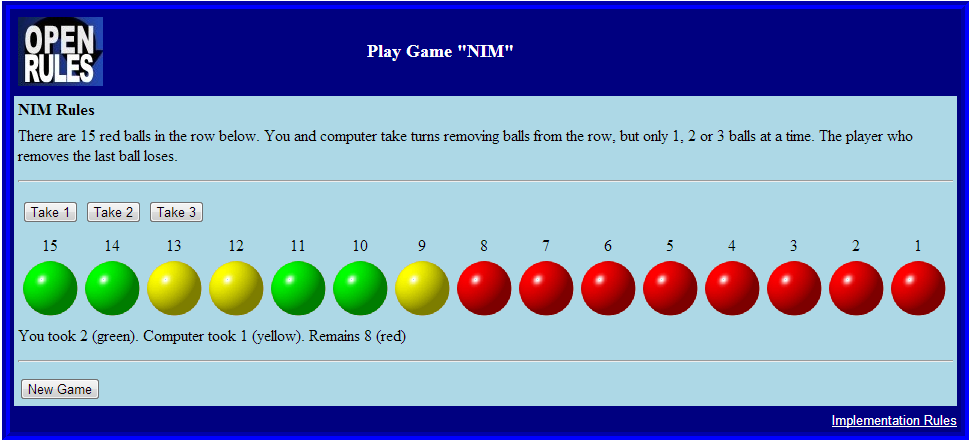 Previously this web application was deployed at the local Tomcat, and I wanted to move it to the Jelastic’s cloud with minimal efforts. And I had almost no problems of doing that! Now you may try to play Nim yourself from the cloud using this URL http://openrules.jelastic.servint.net/Nim/. What have I actually done?
Customizing OpenRules Decisions
The new release 6.2.2 of OpenRules allows a user to customize decisions and decision runs, to create custom decision tables, and to incorporate decisions in web dialogs. Read more at Release Notes
A stable gain in popularity
While I usually prefer to stay away from marketing discussions, I cannot help noticing that during these hard economical times open source business rules products gain in popularity. Continue reading
Dynamic Decision Glossaries
OpenRules decisions use business glossaries that are usually presented in Excel tables that may look like this table “glossary”: Continue reading
OpenRules 6.1.1 is available for downloads
A new release 6.1.1 further advances the Executable Decision Model introduced by the OpenRules-6 in March 2011. It provides new features based on the real-world feedback. In particular, the release 6.1.1 includes more advanced templates for for Decisions, Decision Tables, and Glossaries. It also allows a user to go beyond the limitations of the Decision Model by adding different kinds of decision tables that support rules overrides. Continue reading
About OpenRules Scalability
Being in real-world production environment for many years, OpenRules Engine has a proven record of high efficiency and scalability. Several years ago some of our customers (a major European bank and a large government agency) assigned teams of people to do stress-testing of our product before they decided to use it instead of commercial counter-parts. The results were really good. Continue reading
New decision model videos are available
We have added several video sessions that explain how to use OpenRules to create and maintain different decision models. See the at http://openrules.com/videos.htm
A newly redesigned website
A newly redesigned website www.openrules.com is up and running now. Hopefully our customers and visitors will find it much more attractive and convenient. We are in process to create a new User Manual that will reflect all new capabilities of the Release 6. Continue reading
OpenRules 6 Announced
On March 4 we announced the launch of our new major release OpenRules 6.0.1. It is a very important event in the OpenRules history and probably beyond. It actually brings us much closer to the initial BRMS promise. Continue reading
A major new release 6 is on the way
OpenRules is completing beta testing and documentation for a new release 6 that will allow subject matter experts to create, test, and execute decision models without IT involvement. No Java snippets, no signatures with parameters, no coding is required! You may get a first glimpse of OpenRules-6 at http://openrules.com/decision_model_primer.htm.
Rule Solver is now JSR-331 Compliant
OpenRules has announced that its redesigned Rule Solver™ is now JSR-331 compliant. Rule Solver™ is a long time available optimization component of OpenRules® BRMS that allows users to define and solve constraint satisfaction and optimization problems within a business rules environment. Continue reading
 OpenRules - Decision Intelligence Platform