 I consider myself among the initiators and big supporters of the DMN standard, and I do my best to help bringing the standard to the real-world business decision modeling. Naturally, the current release of DMN includes some constructs with which I strongly disagree but I am trying not to criticize DMN too much as the standard itself is not mature enough yet and I hope it will be gradually improved based on the real-world acceptance. Continue reading
Category Decision Management
Raymond Smullyan’s Retro-Analysis and Decision Modeling
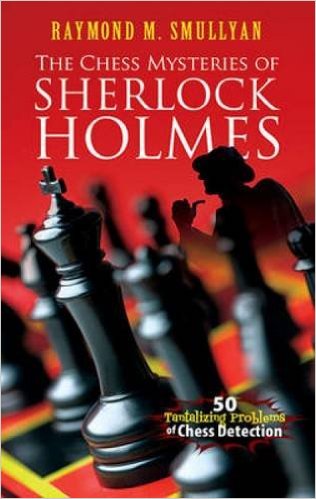 When I learned that the famous Prof. Raymond Smullyan passed away this February at the age of 97, I felt grateful to the man whose books and puzzles my friends and I enjoyed reading as young programmers many years ago. Later on we shared them with our children. I wanted somehow to mark this event and decided to buy his book “The Chess Mysteries of Sherlock Holmes” to read on vacation. Ten days ago I started to read the book during my flight from Newark to Jamaica and… haven’t even noticed as we landed. Continue reading
A new book “DMN in Action with OpenRules”
 This month I published a new book “DMN in Action with OpenRules” at Amazon. This is a practical guide for people who want to understand how to create and maintain business decision models. The guide is based on the DMN standard and OpenRules. It is oriented to business analysts looking to build operational decision models for their own business environment.
OpenRules Implementation of the Loan Approval Challenge
 In Dec-2016 DMCommunity.org published a new Challenge called “Loan Approval“. This challenge actually was proposed by myself based on real-world experience with one of our customers (a large bank). The most important point of this challenge was a general architecture that allows to invoke the same business logic based on real-time events coming from external sources. I described how such architecture may look like at this video that demonstrates a decision engine integrated with a PUB/SUB message broker.
However, the business logic itself also may be interesting especially if implemented using the latest DMN approach. So, I decided to do a new implementation that is described below. Everything is defined in Excel tables with zero Java code. Continue reading
New OpenRules Release 6.4.1 with DMN Why-Analyzer
 “Imagine you had a Why Button handy whenever you encountered some disconnect in day-to-day business operations. Hit the Why Button and presto – answers appear in the form of relevant business rules” – Ron Ross, 2013
The release OpenRules Release 6.4.1 introduces a new add-on called “Why-Analyzer for Decision Modeling” that provides such a Why Button for decision models created in accordance with the DMN standard. Actually it is much more than just a button but rather a graphical interface that allows business analysts to analyze the results produced by their decision models using their own test cases created directly in Excel. See a brief video and try it yourself without any downloads from here. There are several more product improvements described in the release notes. You may download the latest release and try your own decision models with OpenRules Why-Analyzer. Continue reading
Building a Custom Scheduler with OpenRules and JSR-331
One of the largest Japanese telecom company is successfully using OpenRules being integrated with a BPM product produced by our partner Intra-Mart. Last month this customer asked us to help with development of a custom scheduler capable to schedule thousands of cable construction operations subject to various precedence and exclusivity constraints. Continue reading
Dealing With Unknown Data
DMCommunity.org published an interesting challenge  “Greeting a Customer with Unknown Data” that deals with the real-world decision modeling issue: your decision model has to produce a meaningful outcome even when expected input is not available. We provided our DMN-like solution utilizing various OpenRules constructs – it is described here.
Developing Custom Decision Modeling Languages with Enhanced DMN
The modern Business Rules and Decision Management Systems help users to move business logic from a code to business rules controlled by subject matter experts (not developers). In particular, the latest Decision Model and Notation (DMN) standard [1] defines powerful and broadly applicable concepts for decision modeling that allowed experts [2] to call DMN a “decision modeling language”. DMN even includes a friendly enough expression language, FEEL, to express complex relationships between different decision variables. However, DMN is a general purpose “decision modeling language” that naturally stays away from domain-specific decision modeling constructs. In this article I will discuss how to enhance DMN to support specialized decision modeling languages. Continue reading
Business Rules and Tacit Knowledge
Listening several recent presentations of Pragmatic Dave Thomas (see this and this), I cannot help getting back to the fundamental decision modeling problem: Rules vs. Tacit Knowledge (or Intuition). Continue reading
Decision Models: Finding Alternative and Optimal Decisions
People frequently assume that a good, consistent decision model should produce one and only one decision (solution) for any valid input. However, in real-world applications we frequently deal with situations when a decision model may produce multiple feasible solutions for the same input. And it does not mean that the decision model is incomplete – simply a user may choose the most appropriate solution among all produced decisions. It can be done interactively or by adding more rules. I’ve already provided an example “Monkey Business Analyzed” that describes how to deal with multiple decisions using OpenRules What-If Analyzer. In this post I will describe another decision model that also shows how to choose an optimal decision among multiple feasible decisions. Continue reading
“Monkey Business” Analyzed
I decided to add the decision model “Monkey Business” to our new What-If Analyzer. It brought several considerations missed by other solutions. In this post I will discuss my implementation and will show how What-If Analyzer helps to do a through analysis of usually unnoticed aspects of business decision modeling. Continue reading
bpmNEXT 2016
This year OpenRules will participate in the bpmNEXT 2016 that will take place at Santa Barbara, CA on April 19-21, 2016. This is a very selective conference that does not allow marketing and forces the presenters to do only live demonstrations of specific achievements that have a chance to shape the next generation of Business Process Management software – including intelligent operations, the Internet of Things, case management, business decision management, and goal-directed processes. I will present “Dynamic Decision Models: Activation/Deactivation of Business Rules in Real Time” on Apr. 21 at 14:00. Continue reading
Decision Model for Vacation Days Calculation
This month DMCommunity.org asked to present the best design of the notorious decision tables offered by Prof. Jan Vanthienen. It should implement the following business logic: Continue reading
OpenRules 6.3.4 Introduces What-If Analyzer of Decision Models
On December 28, 2015 we published a new OpenRules release 6.3.4 that introduces What-If Analyzer, the first tool of this type in the Decision Management domain. Its main purpose is to support what-if analysis of decision models built in accordance with the DMN standard. What-if analysis is the process of changing the business rules that represent business logic to see how those changes will affect the outcome of the decision model. Here is the main view of the What-If Analyzer for the decision model “Make a Good Burger” offered by the DMCommunity.org: Continue reading
Automatically Learned Business Rules: Should We Understand Them?
Question: Should we worry that we’re building systems whose increasingly accurate decisions are based on incomprehensible foundations?
I’ve just posted an article with the same name at the LinkedIn Pulse that addresses this question. It is especially important in the context of rules-based decision making when rules that govern our decisions have been automatically generated using predictive analytics techniques. I shared two examples from OpenRules experience that explain why the automatically generated business rules should be comprehensible. The first one talks about the use of our Rule Learner at IRS. The second example deals with our Rule Compressor.
“Old” and “New” Business Rules Approaches
The recent LinkedIn discussion “What rules representation to choose for which audience?” came to the question about business analysts handing their business rules written in plain English over to IT for an implementation. Continue reading
Don’t Program a System, Educate It!
Modern decision management techniques enable business decisions by supporting a path from data to decisions and actions. Wherever people use stand-alone Business Rules, Complex Event Processing, Predictive Analytics, Optimization systems or their combinations, they prefer to put in charge subject matter experts and not software developers. Actually, all these systems tend to be declarative and allow customers to feed their systems with externally maintained business knowledge, e.g. historical data and/or already known business rules. Nowadays people in a way want to educate a general purpose system with their domain-specific knowledge avoiding traditional programming. Continue reading
Presentation at BBC-2015: Good Old UServ Product Derby in the Brave New World of Decision Management
James Taylor and I are giving a session at this year’s Building Business Capability conference on “Good Old UServ Product Derby in the Brave New World of Decision Management“at 4:50pm on the Wednesday of the show. Continue reading
Decision “Make a Good Burger”
DMCommunity.org published an interesting June-2015 Challenge called “Make a Good Burger“. Below I describe an OpenRules-based decision model that provides various solutions for this problem. Continue reading
DMN 1.1 Issues: Aggregation
DMN defines “aggregation” in the following way:
“Multiple hits must be aggregated into a single result. DMN 1.0 specifies six aggregation indicators, namely: collect, sum, min, max, average. Optionally, the aggregation indicator may be included in the table. The default is collect.”
Below is a list of my issues with this DMN 1.0 approach. Continue reading
DMN 1.1 Issues: Multi-Hit Decision Tables
In an ideal world we would limit ourselves to Single-Hit decision tables that cover all possible combinations of the involved decision variables. However, DMN rightfully introduced so called “multiple hit” (or “multi-hit”) decision tables to stay closer to the decision modeling reality. Continue reading
Enhanced Live Catalogs at DMCommunity.org
A few years ago, I wrote a web application that allowed professional communities to support Live Catalogs of different software tools. The “live” means that a product catalog is automatically updated whenever the profiles of products included into the catalog are added or updated by their authors. Continue reading
Decision Model “Vehicle Insurance – UServ Product Derby”
As a response to the DMCommunity.org challenge, I will describe an OpenRules-based implementation of the highly popular use case known as “UServ Product Derby”. The use case deals with automobile insurance problems including eligibility and pricing decisions for a hypothetical insurance company “UServ”. Its detailed description can be found here. Our implementation may be considered as another complex-enough example of the DMN approach. Continue reading
Decision “Determine a Killer of Aunt Agatha”
Could we use decision tables to represent and solve complex logical problems? An example of such problem was offered by the DMCommunity.org in the Nov-2014 Challenge called “Who Killed Agatha“. Continue reading
A Little Story From OpenRules Trenches
I’d like to share a little story from our recent consulting experience. Being in the midst of helping our client to deliver a large OpenRules-based banking system, we received an urgent request. The problem should be familiar to many businesses who deal with NAICS (the North American Industry Classification System). Continue reading
OpenRules Test Harness
A new OpenRules Release 6.3.1 enhances its Test Harness with automatic comparison of expected and actual decision execution results. Continue reading
Learning Business Rules from Data at RuleML-2014
This year RuleML-2014 will be held in Prague on Aug 18-20. For the first time it will include a special track called “Learning Business Rules from Data”. As a member of the organizing committee, I posted the proper announcement here. It promises to become a very interesting event when the decision management practitioners meet their academic partners. Continue reading
Can a Decision Model Define Uniqueness of Objects inside a Collection?
This question was asked by Antonio Plais – see the LinkedIn discussion. Several practical variations of this question were mentioned: 1) Define if the same product appears more than once in the same sales order; 2) determine the uniqueness of records in a file to be loaded into a Data Warehouse. Obviously, the question deals with business rules defined on collections of objects – not the most popular topic among decision modelers. Continue reading
Another DMN Decision Model (executable!)
Today Nick Broom published his own example of a decision model based on his understanding of the current version of the DMN standard. Nick is a business analyst and a well-known decision management practitioner, so his interpretation is very valuable as the standard is oriented to the business analysts (not to programmers). Nick’s example is supposed to make a decision whether an applicant is eligible or ineligible to a credit card. Nick described a simple credit card application process and designed decision requirements diagrams and related decision tables.
Starting to read his post, I decided that it could be helpful to make Nick’s decision model executable and to test if it actually produces the expected results. It took me several hours to do it using mainly Excel and the latest version of OpenRules BDMS. Continue reading
My LinkedIn Discussions
LinkedIn today is probably the most popular social network for professionals. Looking for one of my old posts, I noticed that it is not so simple to find it and many people have troubles to do it. However, when you click on your name inside any discussion you will receive links to everything you posted but only within one discussion group. Here are LinkedIn discussions that I’ve started in several groups: Continue reading
2013 => 2014
2013 was a year when OpenRules became 10 years old. These days it is a mature BR&D (Business Rules and Decision) Management product used by thousands of customers worldwide. The following statistic from http://openrules.com demonstrates the constantly growing popularity of our product: Continue reading
API for Generation of OpenRules Decision Tables in Excel
With a new release 6.2.6 of OpenRules® you may generate Excel files with multiple decision tables using a simple Java API. It includes class DecisionBook that corresponds to one Excel workbook (an xls-file), to which you may add multiple OpenRules® decision tables. Continue reading
Live Catalogues of Decision Management Tools
Today I am pleased to announce availability of the new Decision Management Community website called www.decision-tools.org. What is it all about? Continue reading
OpenRules at Decision CAMP 2013
OpenRules is one of the initiators and sponsors of the DecisionCAMP-2013, the
first event for Decision Management practitioners, which will be held in San Jose, CA on Nov 4-6. This event attracted many well-known experts in the business rules and decisions management area – see the agenda. We expect ~250 attendees. OpenRules will participate in the following mini-events: Continue reading
OpenRules in Japan
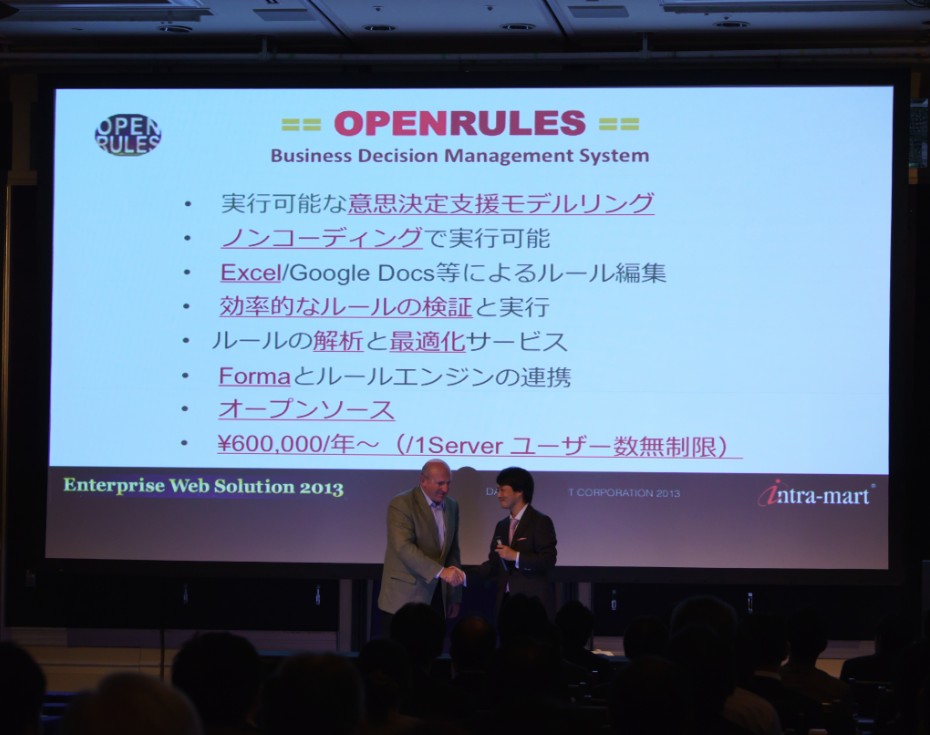
Dr. Feldman and Mr. Nakayama, CEO at Intra-Mart
I’ve just returned from my first ever trip to Japan. I am coming back home to the US with very bright impressions of the Japanese culture and people. I was especially impressed by the deep respect and high professionalism with which people in Japan perform their jobs independently of how small or important those jobs are. I deeply appreciate the friendliness and readiness to help from people on the streets of Tokyo and Kyoto that I have not seen for a while.
This visit was organized by our Japanese partner NTT Data Intra-Mart. Continue reading
Solving Rule Conflicts – Part 2
“The Sleep of Reason Produces Monsters”, Francisco Goya
Defeasible Logic and Business Rules with Probabilities
Modern rules and decisions management systems provide effective mechanisms for development of good decision models. However, building real-world decision models people always face complex issues related to diagnostic and resolution of rule conflicts. Some systems can effectively verify decision model consistency and diagnose rule conflicts. But there are no practically used Business Rules (BR) products that claim that they may automatically resolve rule conflicts.
In the Part 1 of this series I described how end users can represent their rules in single-hit and multi-hit decision tables while avoiding rule conflicts. But is it possible to automatically resolve rule conflicts? I will discuss this problem below. Continue reading
Solving Rule Conflicts – Part 1
Representing Contradictory Rules with Single-Hit and Multi-Hit Decision Tables
Modern rules and decisions management systems provide effective mechanisms for development of good decision models. However, building real-world decision models people always face complex issues related to diagnostic and resolution of rule conflicts. Some systems can effectively verify decision model consistency and diagnose rule conflicts. But there are no practically used Business Rules products that claim that they may automatically resolve rule conflicts (at least I am not aware of them). As a result, it becomes a responsibility of users to represent rules in such a way that allows them to avoid conflicts. Continue reading
Webinar: Creating and Managing Executable Decision Models with DecisionsFirst Modeler and OpenRules
Watch Recorded Webinar
We are pleased to announce a joint free webinar organized by Decision Management Solutions and OpenRules.
Determine the Risk of Meeting a Werewolf
Today there was a post at the LinkedIn group “Looking for a simple example of representing calculations in a Decision Model” with this problem description: Continue reading
Combining Constraint Solving with Business Rules and Machine Learning – CoCoMiLe 2013
The integration of different decision making techniques finally is finding its home under the roof of the Decision Management movement. I am glad that an integrated Constraint Programming (CP), Business Rules (BR), and Machine Learning (ML) approach is gaining in popularity as well. An interesting workshop “CoCoMiLe 2013 – Continue reading
Rule Violations and Over-Constrained Problems
“Learn the rules like a pro, so you can break them like an artist.” – Pablo Picasso
Practical people know that one of the most important property of a business rule is its ability to be violated. Here are a few examples:
Decision Execution Reports
OpenRules Release 6.2.3 adds an ability to generate decision execution reports in the HTML format. These reports help a rule designer to analyze which rules were actually executed and in which order. Continue reading
How to compact large decision tables
A well-known problem with decision tables is that they frequently become too big and too difficult to manage. It is also well-known that OpenRules utilizes Excel-based decision tables as its major representation mechanism for business rules. So, I decided to share some methods used by our customers to make large decision tables more compact. Continue reading
Customizing OpenRules Decisions
The new release 6.2.2 of OpenRules allows a user to customize decisions and decision runs, to create custom decision tables, and to incorporate decisions in web dialogs. Read more at Release Notes
Fall 2012 – Time for Conferences
As usual, every fall OpenRules participates in major international conferences devoted to intelligent decision making. Here is a list of this year conferences from our website: Continue reading
Fischer vs. Kasparov vs. Karpov
On a long flight back to the US I had a few hours to kill. So, I decided to implement one of my favorite modeling tests that I used to give to my students and they always enjoyed it. This time I wanted to try it myself with the newest OpenRules Decision Modeling facilities (see Rule Solver).
Virtual Chess Tournament
Three world champions Fischer, Kasparov, and Karpov played in a virtual chess tournament. Each player played 7 games against two other opponents. Each player received 2 points for a victory, 1 for a draw, and 0 for a loss. We know that Kasparov, known as the most aggressive player, won the most games. Karpov, known as the best defensive player, lost the least games. And Fischer, of course, won the tournament. Continue reading
Rule Engines: RETE and Alternatives
The famous RETE algorithm was invented by Dr. Charles Forgy more than 30 years ago and it still remains the foundation for most implementations of inferential rule engines. Recently Carole-Ann asked the question: why after all these years there were no practical alternatives to RETE? Continue reading
Modeling Decisions for Scheduling and Resource Allocation Problems
“Reality is built in wonderful simplicity”, Eliyahu Goldratt “The Choice”
Scheduling and Resource Allocation are traditionally considered as very complex business problems. They are usually out of reach for the most rule engines. I personally learned how to deal with these complex problems during my real-world consulting practice by applying a great product called “ILOG Scheduler” written by Claude LePape and Jean-Francois Puget 20 years ago. I’ve just googled the product name and got this User Manual that has over 600 pages with a lot of C++ code. I used to teach ILOG Solver/Scheduler courses and will reuse some examples borrowed from them. Continue reading
Different Decision Tables for a Very Simple Use Case
The responses to the RFP of OMG DMN (Decision Model and Notation) standard are scheduled to arrive in May of 2012. Trying to keep this process as close as possible to the everyday decision management reality, I posted several use cases at the DMN Discussion Group and tried to formulate down-to-earth questions that DMN will hopefully address. Here I want to take almost trivial rules and discuss different implementation options using decision tables. Continue reading
Dynamic Decision Glossaries
OpenRules decisions use business glossaries that are usually presented in Excel tables that may look like this table “glossary”: Continue reading
 OpenRules - Decision Intelligence Platform