OpenRules Release 11.2.1 updates third-party dependencies to address security and compatibility requirements.
Key Updates:
- Spring Boot 4 support
- AWS SDK for Java v2 support
These updates address highly requested customer requirements.
OpenRules Release 11.2.1 updates third-party dependencies to address security and compatibility requirements.
Key Updates:
These updates address highly requested customer requirements.

Decision Playground is now publicly available. Announced on January 15, 2026, this powerful interactive component of the OpenRules Decision Intelligence Platform enables business users to visually experiment with scenarios, compare alternatives, and optimize decisions—without modifying the underlying models. See how Decision Playground helps a subject matter expert choose the best decision (not necessarily the optimal one) when unexpected constraints emerge: Inside/Outside Production. For more information, click here.

DMCommunity.org offered a relatively simple challenge “Christmas Word Search” for holidays. My first inclination was to ask an LLM to solve it. I certainly was impressed that Copilot (or another LLM-based tool) could quickly build a code to find a correct solution. But then I thought: “Can I, a human, do better than LLM preferably without coding?” Below I describe my experiments from this morning.
Continue reading
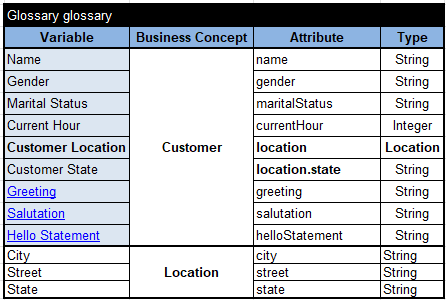
Being at the heart of any decision model, OpenRules Glossary uses mandatory columns “Variable Name”, “Business Concept”, “Attribute”, and “Type” to define all used decision variables. It also may include many optional columns such as “Description”, “Used As”, and “Default Value” that allow you to effectively control the input and output of the decision model [read more]. The new OpenRules Release 10.4.1 adds new features to the Glossary that allow our customers to build more flexible JSON interfaces for OpenRules Decision Services.
Continue reading
In October-November of this year, OpenRules successfully provided Training/Consulting services for different business units of a major US insurance company. Working closely with their business analysts and software developers, we managed to develop and deploy decision services that became working prototypes for the production-level systems. Contact support@openrules.com if you want to quickly put together a pilot of your decisioning system.

OpenRules just announced a new Long-Term-Support (LTS) Release 10.4.0 built in accordance with OpenRules Lifetime Release Policy. This policy puts you in control of your upgrade strategy by making it easier for you to plan and budget for OpenRules’ product upgrades. Our Long-Term-Support releases are designed to be stable and reliable. They undergo extensive testing and are regularly updated with bug fixes to ensure they are optimized for use over an extended period of time. This stability is crucial for larger businesses and organizations that rely on OpenRules for their critical day-to-day operations. When it’s time to upgrade, as a licensed customer you’ll have rights to major product releases. Thus, you can benefit from OpenRules product stability and leadership in constantly improving decision intelligence technology.
Continue reading
Real-world decision models usually execute multiple decisioning steps in a certain order. Whether the execution order is defined manually or automatically, the good design does not need to be explicitly interrupted if, after every execution step, the decision model validates the expected results and directs the execution to the correct branches. However, sometimes you still need to interrupt the execution of your multi-hit decision table, to break your iteration loop, or even to terminate the execution of your entire decision model. This post shows how to deal with such situations using OpenRules predefined actions “ACTION-BREAK” and “ACTION-TERMINATE”..
Continue readingOpenRules Release 10.3 adds an ability to create complex English-like expressions inside your decision tables. With new predefined functions for lists and arrays of business objects, you don’t need to use loops in many practical situations. Consider a relatively simple example.
Continue reading
OpenRules Decision Manager becomes so powerful and easy to use that it dramatically reduces the efforts needed to develop new decision models and deploy them on cloud as decision microservices. OpenRules team has great practical experience of rapid creation of working prototypes or Proof of Concepts (POC). That’s why we offer a FREE POC development. After a brief meeting, we quickly (usually within 1-3 days!) put together a POC tested locally and deployed on cloud, so the customer may start testing it remotely without any installations! Read more Continue reading

OpenRules RuleSolver is an open source tool that adds the power of Constraint and Linear Programming to Business Decision Modeling. It extends OpenRules Decision Manager to support Declarative Decision Modeling and Decision Optimization.
The newest OpenRules Release 10.1.0 comes with an essentially simplified RuleSolver which now requires only two tables “DefineVariables” and “PostConstraints“ to define many complex logical problems. It also provides predefined methods for problem resolution so you really may concentrate only on the question “WHAT” and not worry about “HOW”. I will demonstrate the new decision modeling facilities using a relatively complex logical problem “Family Riddle“.
Continue reading
OpenRules Release 10.1.0 is now available. New capabilities include:
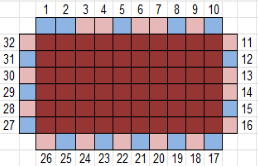
DMCommunity Challenge July-2023 deals with a rules-based decisioning problem when not all rules can be satisfied and thus should be considered as preferences. It offers an advanced version of “Miss Manners” (see OpenRules solution) with not equal numbers of males and females at each party. So, the seating arrangement “boy-girl-boy-girl and each guest has someone on the left or right with a common hobby” becomes not a Rule but a Preference. It makes the problem much more difficult to represent and solve especially if we want to find an optimal seating. In this post I will demonstrate how to build the corresponding business decision model using the latest version of OpenRules Rule Solver.
Continue reading
In real-world decision models, you may want to write business rules that refer to combinations of two or more individual decision variables called composite decision variables. For example, your business concept “Department” may have a decision variable “Manager” of the type “Employee” which is another business concept with such variables as “Name”, “Salary”, “Gender”, etc.
Continue reading
This problem used to be one of the popular benchmarks for rule engines 20 years ago. And now DMCommunity.org brings it back to see how modern decision engines can represent and solve this problem today. I will demonstrate it in this post with the latest OpenRules Rule Solver.
Continue readingIn real-world decision models, our customers deal with complex business glossaries. In particular, it is quite common when one business concept refers to other business concept and it is not immediately clear how to define and use such references. I will explain how it’s supposed to be done in OpenRules. let’s consider a simple example “HelloNestedLocation” with the following glossary:
Iterating over collections (arrays) of decision variables is a frequent need in real-world decision models. For example, the following decision table defines if a company has high-paid employees:

The iteration here is defined by the [for each Employee in Employees] in the first row. The ACTION-BREAK in the column “ActionExecute” will force the iteration process to stop (break) when the very first high-paid employee is found.
Continue readingIn this post we describe an OpenRules decision model that addresses DMCommunity.org Mar-2023 Challenge “Permit Eligibility”. The Challenge asks to implement this rule: “An applicant is eligible for a resident permit if the applicant has lived at an address while married and in that time period, they have shared the same address at least 7 of the last 10 years.” There is already 2 DMN-based solutions published by Bruce Silver who explained that this simply sounding rule requires to address several not so simple considerations. There is also an attempt to create a decision model with ChatGPT, which I analyzed and converted to a working Java code. I asked an OpenRules developer Alex Mirtsyn to look at this problem, and together we came up with a solution described in this post.
Continue reading
OpenRules, Inc. is now 20 years old! Our team met this anniversary in the best possible way – we did not notice it! We are so busy with adding new powerful capabilities to OpenRules products and supporting our real-world customers. I described a brief history of our company and our development plans 5 years ago. Since then we overperformed by introducing OpenRules Decision Manager which became one of the fastest and user-friendly Decision Intelligence Platform available on the market today. More and more major corporations worldwide choose OpenRules for intelligent business automation. Stay tuned: 20-year-old OpenRules with proven records and unique R&D capabilities is working on new breakthroughs.

The Holidays season is upon us, and OpenRules team wants to express our sincere appreciation to all our customers and colleagues around the world. In 2022 we made very serious enhancements to OpenRules products and apparently our customers like them. We promise to make OpenRules even more powerful and user-friendlier in 2023. We wish you and your families all the best in the coming New Year!

Our team worked hard to prepare a nice Thanksgiving gift for our customers, and today I am happy to announce general availability of OpenRules-9! This major new release comes with a new implementation of our Graphical Explorer and Debugger as a foundation for the current and future OpenRules Interactive Decision Modeling Environment oriented to business users. Watch new Intro Video, read Release Notes 9.0.0, and evaluate it for free. Happy Thanksgiving!
Continue readingOpenRules Decision Manager Release 8.5.3 adds several advanced features such as simplified iterations over collections of objects, new operators, multiple rules in CSV-based decision tables, upgrades dependencies, and more. See Release Notes 8.5.3
OpenRules, Inc. offers fast support online sessions to help you to start working with OpenRules or to address your technical problem. Upon your request, an OpenRules expert will send you an invite to a remote-support session addressing your particular problem by studying it together with you on your own computer. Anytime you also may order a paid fast-support service that costs only $60.00 USD for up to a 1 hour support session. Link

Decision tables is the most popular mechanism for representation of business logic – no wonder they play the major role in the DMN standard. However, when it comes to analyzing large amount of data, standard decision tables may not be the best way to do it. In this post, I’ll describe a much better approach implemented in OpenRules.
Continue readingThis new Release 8.4.0 is a response to practical needs of our large and mid-size customers. It essentially enhances deployment capabilities including:
Read Integration/Deployment, Release Notes, an updated User Manual for Developers, and try it from here.
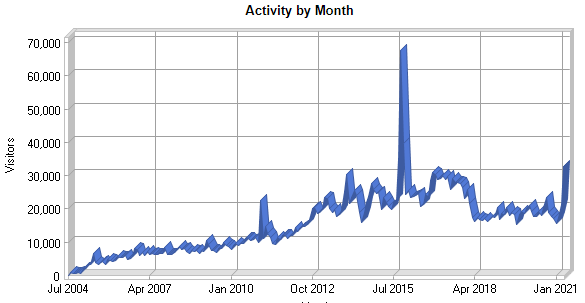
Since the beginning of 2021 OpenRules Decision Manager‘s popularity is growing at an unusually high pace. The last month our website had 33K visitors that is much more than traditional 20K visitors per month. We’ve already closed several very important deals this year, and now several other large customers have successfully completed their POCs building and deploying OpenRules-based decision microservices on their preferred clouds. Here are important factors that contribute to this success:
Continue reading We will run a webinar series about OpenRules products starting on Feb 5, 2021:
“Decision Modeling with OpenRules Explorer – Introduction” – Free Registration
Watch Recording
Next Webinars: Continue reading
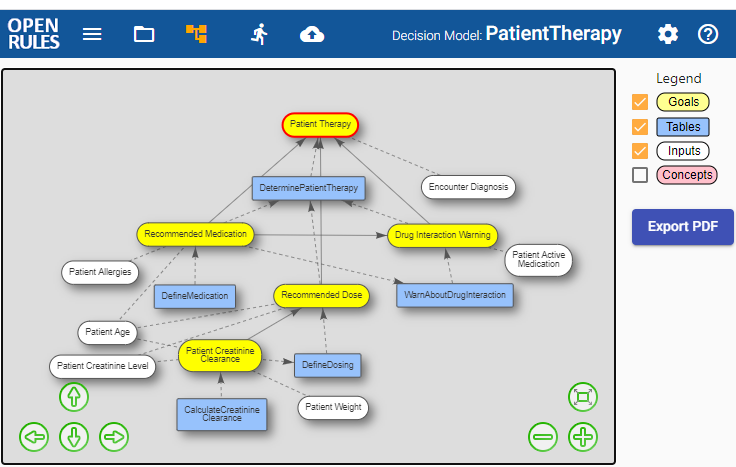 New OpenRules Decision Manager Release 8.3.0 comes with a Graphical Integrated Decision Modeling Environment called “Decision Model Explorer“. It automatically builds decision model diagrams, opens Excel files associated with different nodes, and allows business people to modify, test, and deploy their decision models from one place. Watch the video and read more. Join our free webinar on Feb 5, 2021 – register here. Continue reading
The new OpenRules Decision Manager 8.3.0 along with “Decision Model Explorer“ includes an ability to define some decision variables by using formulas directly in the Glossary. For instance, in the standard sample “PatientTherapy” we can modify the glossary as follows:

OpenRules Decision Manager deploys decision models as cloud-based decision services such as AWS Lambda with “one-click“. In this post I will explain how to invoke deployed OpenRules services from any Java application. There are at least 3 options:
You can try to run all three options using the sample decision project “VacationDaysLambda” included in the standard OpenRules installation. Continue reading
Many popular languages (e.g. Angular or Mustache) use text interpolation to incorporate dynamic string values into the text. OpenRules Decision Manager Release 8.2.1 gives our customers an option to use text interpolation by putting text decision variables in the double curly braces {{ and }}. For example, see how it’s being used in the standard sample project “PatientTherapy”:
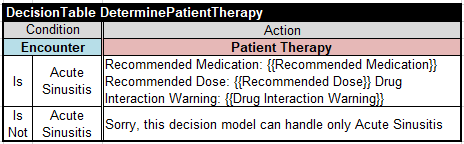
 On June 15 OpenRules, Inc. released OpenRules Decision Manager 8.2.0 that summarizes major advances made in the first half of 2020 in the following areas: Continue reading
 Traditionally when we ran an OpenRules-based decision model using a script “test.bat”, a user received an execution protocol on the console view, a “black” screen. While it showed all executed rules, it still was difficult for a user to find all changes especially when there are too many rules. The latest release of OpenRules Decision Manager essentially beatifies rules execution protocols and reports showing all rules in a hierarchical order and highlighting the variables which values that were actually changed. Continue reading
OpenRules decision tables use to column of the type “ActionExecute” to invoke another decision table by simply using its name. For example, look at this decision table:

 Our customers deploy OpenRules decision services using multiple cloud-based microservices, on premise servers, or smartphone apps. Multiple production instances can be too expensive and our customers want to have a clear pricing model for as many decision services as they want to maintain independently how these services are being deployed. We listened and came up with a new pricing model that consists of two license types, Development License and Run-Time License:
Continue reading
 OpenRules Decision Manager takes an Excel-based business decision model and converts it into highly efficient Java code. When you make changes to the business model, the code will be automatically re-generated, so we do not expect you to even look at this code. The authors of business decision models will always maintain their original models using mainly Excel.
OpenRules Decision Manager offers several integration and deployment facilities for converting your business decision models to operational decision services on-premise or on-cloud. We want you to be able to go through the deployment process without programming or complex configuration. This process should be easily repeatable as you will need to do it again and again when you modify your original business decision models. So, we tried to simplify the deployment process as much as possible. As our customers started to explore different deployment options, we plan to post several articles that describe these options in more details using the standard examples included into the OpenRules Decision Manager 8.1.1 installation.
 This month OpenRules Decision Manager became the first SaaS Rule Engine available in AWS Marketplace. It gives our customers an opportunity to execute OpenRules-based decision services using a “Pay-As-You-Go” pricing model. You may read the Press Release approved by the AWS Marketplace team. Using your AWS account, you can now subscribe to our AWS SaaS Subscription that allows you to pay a minimal fee for only what you actually use with all charges coming from Amazon AWS Marketplace. Continue reading
 OpenRules Release 8.1.0 essentially enhances both OpenRules Decision Manager and classic OpenRules BRDMS making them faster and easier to integrate with any existing applications.
OpenRules Decision Manager 8.1.0 along with further improved performance includes the following improvements: Continue reading
 2019 has brought lots of innovations and positive developments for OpenRules and its customers. This post summarizes all the new capabilities and user experiences that we have introduced in 2019. Continue reading

OpenRules business decision models can be deployed as operational decision services utilizing the Serverless architecture provided by Amazon Web Services (AWS), the most powerful and popular cloud platform in the modern world. When you deploy your decision models as AWS Lambda functions, you don’t even think about servers and pay only for the execution time your services actually consume. Continue reading
On Aug. 1 we made OpenRules Decision Manager publicly available for the first time – everybody can download and try its free evaluation version. This 3 mins YouTube video provides a very simple introduction to the on-premise version of our new product that now can execute exactly the same decision models as the classic OpenRules BRDMS.
The major advantage of the Decision Manager is the fact that it is well-positioned to be used on cloud utilizing server-based or serverless architectures. It perfectly fits the requirements of the modern microservices and is ready to support decision-making applications which handle the millions of complex rules-based transactions per day when every transaction should be executed within milliseconds. The next upcoming release of OpenRules® Decision Manager will provide a cloud-based UI for analysis, debugging, automatic deployment and execution of decision models as microservices – stay tuned!
 OpenRules Release 8.0.0 adds one more nice feature requested by our customers. Usually business decision models are created by a business person in Excel using powerful OpenRules decision tables. The same people who create the decision models usually create test cases for them using special Datatype and Data tables. After the model is tested, the business person passes the Excel-based model to IT for integration. If their IT uses Java, they need to create Java classes for input and output objects. which are similar to the Datatype tables created by the business person. The release 8.0.0 added an ability to generate such Java classes automatically to provide ready-to-go interfaces for already tested decision models. Continue reading
 The latest OpenRules Release 8.0.0 comes with a new, very simple Java API for incorporation of business decision models created by business people in Excel into Java applications. It corresponds to the simple view of a decision model as “a Business Glossary surrounded by Decision Tables that specify decision logic for Goals and Sub-Goals“. OpenRules 8.0.0 explicitly introduced Java concepts “DecisionModel” and “Goal” to support the Goal-Oriented Decision Modeling approach described in this book. Continue reading
 OpenRules announced an availability of the new product “Decision Manager” that has been developed specifically for modern enterprises allowing their business analysts to create, deploy, and manage Business Decision Services on cloud, on premise, or even on smartphones. It comes with a completely new execution mechanism that is extremely fast, takes almost no time to start, and essentially reduces the memory footprint. It perfectly fits the requirements of modern containerized decision microservices.
OpenRules also announced the availability of the new release 8.0.0 of its Classic OpenRules BRDMS that includes many new features requested by customers – Release Notes 8.0.0. It is important that both products can efficiently execute the same Business Decision Models created using MS Excel or Google Sheets in accordance with OpenRules Goal-Oriented Decision Modeling approach described in this book.
 Our customers frequently build not one but multiple decision models for their business domains like property and casualty insurance, loan origination, medical guidelines, etc. After building several decision models, they already have a quite rich glossary and various decision tables that essentially cover their business domain. So, it gives them a good foundation to build a library of relatively small decision models which can be used to assemble more complex decision models. Sometimes they even add domain-specific decision tables and supporting Java classes. This PDF document uses well-known loan origination problems (described in the Chapter 11 of the DMN specification) to explain how to build and utilize a library of decision models. Link
Dear Customers,
I ’m Jacob Feldman, the CTO of OpenRules, Inc. I wanted to reach out to wish you a Happy New Year and thank you for your ongoing support of OpenRules. 2018 was a very successful year for OpenRules. We essentially advanced our decision engine to support a new decision modeling approach. We also received the Business Rules Excellence Award. For those of you who have already experienced the latest OpenRules Release 7.0.0, I hope you are seeing the benefits of the work we did during the last few years to improve the OpenRules robustness, reliability and simplicity of use. Continue reading
 OpenRules was introduced to general public as an open source product 15 years ago, and over these years it has become one of the most popular business rules and decision management systems. Every day OpenRules helps customers worldwide handle millions of transactions in real-world production environments for large corporations, government agencies, hospitals, and online businesses – see the list of selected customers. In 2018, along with the Business Rules Excellence Award, we received an overwhelming number of requests from organizations wanting to migrate their existing rules-based systems to OpenRules. This growing interest can be explained by this quote from Forrester Research: “OpenRules have the most-aggressive approaches to business-expert authoring and typically requires less developer support than IBM ODM, FICO Blaze Advisor, and Red Hat Drools“.
So, staring January-2019 we are essentially expanding our technical support and consulting services to help our customers move to OpenRules faster and provide them with superior support. On December 31, 2018 we announced new OpenRules Migration Services – click here to learn how they work.
On October 16 Business Rules Excellence Awards (BREA) announced the winners of the 2018 Awards. Congratulations to the OpenRules’s customer, a major California bank, who became a winner! Here is the brief from the BREA’s presentation:

After successfully putting a new OpenRules-based system in production, the bank extended the use of OpenRules to another mission-critical application related to risk management. Below you can read the description of this OpenRules success story. Continue reading
The July’s challenge “Zoo, Buses, and Kids” deals with a very simple optimization problem:
“300 kids need to travel to the London zoo. The school may rent 40 seats and 30 seats buses for 500£ and 400£. How many buses of each to minimize cost?”
Naturally, a constraint solver nicely and easily solves this and more complex constraint satisfaction problems as shown in Philippe Laborie’s solution. When today I saw a pure SQL solution provided by Damir Sudarevic, I thought that it’s time to model this problem as a business decision model. It would not be as compact as provided solutions, but it should be oriented to business users. Continue reading
 OpenRules - Decision Intelligence Platform