A well-known problem with decision tables is that they frequently become too big and too difficult to manage. It is also well-known that OpenRules utilizes Excel-based decision tables as its major representation mechanism for business rules. So, I decided to share some methods used by our customers to make large decision tables more compact. Continue reading
2012 in review
Happy 2013 to all OpenRules customers, colleagues, and friends! The WordPress.com prepared a 2012 annual report for this blog.
Search and Replace in Multiple Excel Files with IceTeaReplacer
I believe that OpenRules users will find that a new free tool called “IceTeaReplacer” can be very useful for doing search&replace in OpenRules repositories. Here is a functional description from their website: Continue reading
Deploying OpenRules Applications on Cloud
A week ago at JavaOne Conference in San Francisco I had a chance to talk directly with several providers of cloud deployment solutions for Java applications. I was really impressed with a Ukrainian startup “Jelastic” that just won the Java Community’s version of Oscar and was endorsed by Dr. Gosling – read more here. Coming back home to NJ, I decided to try it myself. I took the existing web application that implements a popular game “Nim” using OpenRules decision tables and forms. It looks as follows:
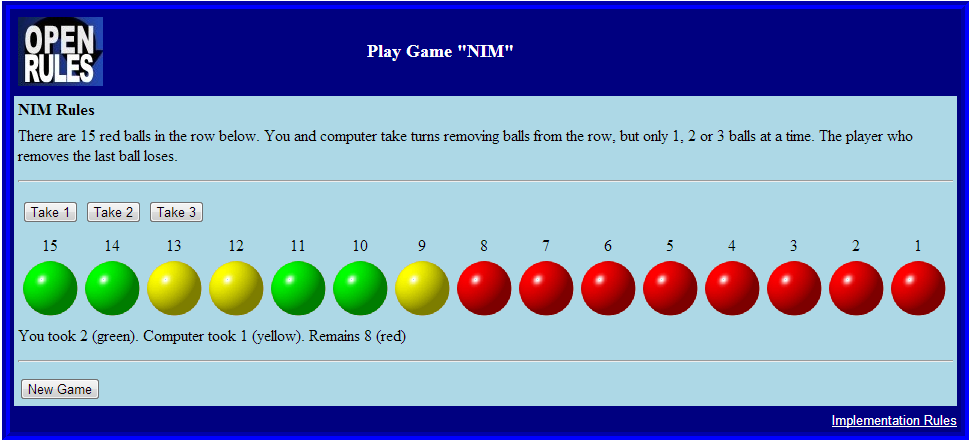 Previously this web application was deployed at the local Tomcat, and I wanted to move it to the Jelastic’s cloud with minimal efforts. And I had almost no problems of doing that! Now you may try to play Nim yourself from the cloud using this URL http://openrules.jelastic.servint.net/Nim/. What have I actually done?
Customizing OpenRules Decisions
The new release 6.2.2 of OpenRules allows a user to customize decisions and decision runs, to create custom decision tables, and to incorporate decisions in web dialogs. Read more at Release Notes
Fall 2012 – Time for Conferences
As usual, every fall OpenRules participates in major international conferences devoted to intelligent decision making. Here is a list of this year conferences from our website: Continue reading
A stable gain in popularity
While I usually prefer to stay away from marketing discussions, I cannot help noticing that during these hard economical times open source business rules products gain in popularity. Continue reading
Fischer vs. Kasparov vs. Karpov
On a long flight back to the US I had a few hours to kill. So, I decided to implement one of my favorite modeling tests that I used to give to my students and they always enjoyed it. This time I wanted to try it myself with the newest OpenRules Decision Modeling facilities (see Rule Solver).
Virtual Chess Tournament
Three world champions Fischer, Kasparov, and Karpov played in a virtual chess tournament. Each player played 7 games against two other opponents. Each player received 2 points for a victory, 1 for a draw, and 0 for a loss. We know that Kasparov, known as the most aggressive player, won the most games. Karpov, known as the best defensive player, lost the least games. And Fischer, of course, won the tournament. Continue reading
Rule Engines: RETE and Alternatives
The famous RETE algorithm was invented by Dr. Charles Forgy more than 30 years ago and it still remains the foundation for most implementations of inferential rule engines. Recently Carole-Ann asked the question: why after all these years there were no practical alternatives to RETE? Continue reading
Modeling Decisions for Scheduling and Resource Allocation Problems
“Reality is built in wonderful simplicity”, Eliyahu Goldratt “The Choice”
Scheduling and Resource Allocation are traditionally considered as very complex business problems. They are usually out of reach for the most rule engines. I personally learned how to deal with these complex problems during my real-world consulting practice by applying a great product called “ILOG Scheduler” written by Claude LePape and Jean-Francois Puget 20 years ago. I’ve just googled the product name and got this User Manual that has over 600 pages with a lot of C++ code. I used to teach ILOG Solver/Scheduler courses and will reuse some examples borrowed from them. Continue reading
In memory of Eliyahu Goldratt
Today searching web for goal programming sources I suddenly learned that last year Eliyahu Goldratt died. He was 64. I remember how impressed I was with his books “The Goal” and “Theory of Constraints” that helped me with an implementation of a custom supply chain system at the end of 90’s. I remember reading “The Goal” aloud to my wife – it was more than another technical book. Not being a native English speaker, he used plain English to explain complex issues in a very unconventional way. Continue reading
Different Decision Tables for a Very Simple Use Case
The responses to the RFP of OMG DMN (Decision Model and Notation) standard are scheduled to arrive in May of 2012. Trying to keep this process as close as possible to the everyday decision management reality, I posted several use cases at the DMN Discussion Group and tried to formulate down-to-earth questions that DMN will hopefully address. Here I want to take almost trivial rules and discuss different implementation options using decision tables. Continue reading
Dynamic Decision Glossaries
OpenRules decisions use business glossaries that are usually presented in Excel tables that may look like this table “glossary”: Continue reading
Representing and Solving Rule-Based Decision Models with Constraint Solvers
The latest rules conferences RulesFest-2011, BBC-2011, and RuleML-2011 were really great events in general and for OpenRules in particular. We announced a new constraint-based Rule Engine that is the first alternative to Rete-based implementations of a real inferencial rule engine. Continue reading
Rules vs. Decisions
There is a question posted yesterday at the OpenRules Discussion Group: “Is there a reason why you would steer actively away from Rules and into Decision?” Continue reading
Fall-2011 Business Rules Conferences
In Oct-Nov 2011 OpenRules will participate in the following major Business Rules events: Continue reading
OpenRules 6.1.1 is available for downloads
A new release 6.1.1 further advances the Executable Decision Model introduced by the OpenRules-6 in March 2011. It provides new features based on the real-world feedback. In particular, the release 6.1.1 includes more advanced templates for for Decisions, Decision Tables, and Glossaries. It also allows a user to go beyond the limitations of the Decision Model by adding different kinds of decision tables that support rules overrides. Continue reading
Forrester about OpenRules
On July 5, 2011 Forrester Research published a report “Market Overview: Business Rules Platforms 2011”. Here is what it says about OpenRules:
“OpenRules have the most-aggressive approaches to business-expert authoring and typically requires less developer support than IBM ILOG, FICO Blaze Advisor, and JBoss BRMS.” Continue reading
James Taylor blogs about OpenRules
James Taylor posted several articles devoted to OpenRules BDMS:
– General Overview
– Rule Solver
– Rule Learner.
I just want to add a news which we have not shared with James yet: our latest release of Rule Learner can also present automatically discovered rules in the PMML format.
About OpenRules Scalability
Being in real-world production environment for many years, OpenRules Engine has a proven record of high efficiency and scalability. Several years ago some of our customers (a major European bank and a large government agency) assigned teams of people to do stress-testing of our product before they decided to use it instead of commercial counter-parts. The results were really good. Continue reading
OpenRules at Business Analyst World in PA on April 4-7, 2011
Now, when OpenRules-6 really allows business analysts to create and execute decision models without help from IT, we started to concentrate more on business analyst events. Continue reading
OMG Decision Model Notation (DMN)
On March 23, 2011 I attended the Object Management Group‘s Decision Modeling Notation (DMN) day in Arlington, VA. There were very interesting presentations from vendors and practitioners devoted to decision modeling in general and decision tables in particular – see the detailed report at the James Taylor’s blog. You may find more information about the DMN in this article. Continue reading
New decision model videos are available
We have added several video sessions that explain how to use OpenRules to create and maintain different decision models. See the at http://openrules.com/videos.htm
A newly redesigned website
A newly redesigned website www.openrules.com is up and running now. Hopefully our customers and visitors will find it much more attractive and convenient. We are in process to create a new User Manual that will reflect all new capabilities of the Release 6. Continue reading
OpenRules 6 Announced
On March 4 we announced the launch of our new major release OpenRules 6.0.1. It is a very important event in the OpenRules history and probably beyond. It actually brings us much closer to the initial BRMS promise. Continue reading
Connecting The Dots
On January 8, 2010 after the notorious “underwear bomber” attack Tom Davenport wrote:
“How easy is it to connect the dots? Granted, there were numerous indications of Abdul Mutallab’s evil intent. But it would have been difficult to put them together before the flight. Combining disparate pieces of information about people – whether they are customers or terrorists – is akin to solving a complex jigsaw puzzle.” Continue reading
A major new release 6 is on the way
OpenRules is completing beta testing and documentation for a new release 6 that will allow subject matter experts to create, test, and execute decision models without IT involvement. No Java snippets, no signatures with parameters, no coding is required! You may get a first glimpse of OpenRules-6 at http://openrules.com/decision_model_primer.htm.
Rule Solver is now JSR-331 Compliant
OpenRules has announced that its redesigned Rule Solver™ is now JSR-331 compliant. Rule Solver™ is a long time available optimization component of OpenRules® BRMS that allows users to define and solve constraint satisfaction and optimization problems within a business rules environment. Continue reading
RulesFest-2010
 |
This year Rules Fest will be held on October 11-14, 2010 in San Jose, CA. This event brings together technical experts and practitioners in decision support technologies. Continue reading |
 OpenRules - Decision Intelligence Platform