Solutions for Oct-2025 Challenge

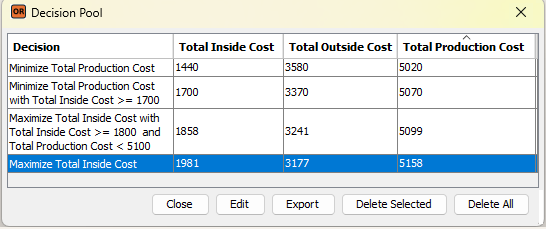
DMCommunity has already received five solutions for its Oct-2025 Challenge “Decision with two objectives” which is looking for decision models that help a web designer to select certain features while satisfying budget and value constraints. It is quite a simple problem for most linear or constraint solvers, so it is no wonder that the first 3 solutions utilized different solvers: Seeker, Pymoo, and OPL CPLEX. What makes this problem more interesting is that it involves two conflicting objectives: total value and total cost. Our decision models are supposed to devise a rational way to trade them against each other.

Continue reading

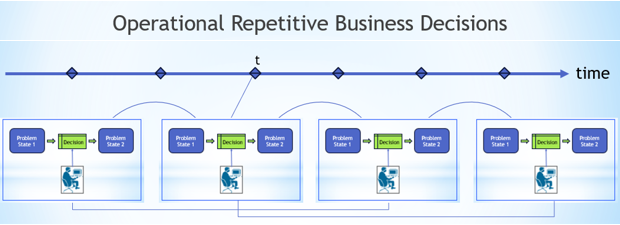
Making Operational Repetitive Decisions Under Uncertainty

While just completed DecisionCAMP-2025 was dominated by the integrated use of Generative AI (LLMs) and Symbolic AI (Rules, Machine Learning, Optimization), in my closing notes I concentrated on the topic of making repetitive operational decisions in the real-world, frequently uncertain environments. In this article, I elaborated why it is important now and will be more important as the AI hype pushes our decision-making systems to even wider use within real-world business processes. Link

Advanced Rule Learner: Building Decision Models from Examples

Today, four days before the start of DecisionCAMP-2025, we announced the public availability of the Advanced Rules Learner, a Machine Learning (ML) product designed for business users and well-integrated into the OpenRules Decision Intelligence Platform. Now it can generate working decision models based only on a set of problem examples. I will demo the latest capabilities during my presentation at DecisionCAMP on Sep 22 at noon EDT. You may preview my slides ahead of time. Why did we decide to enhance Rule Learner?

Continue reading

Business Rules with Regular Expressions

Almost all programming languages support regular expressions. Many search languages allowed simple wildcards, for example “*” to match any sequence of characters, and “?” to match a single character. Non-programmers may use regular expressions in many situations just as well. In particular, business rules may need to define conditions that use regular expressions. Examples of such rules were specified in the DMCommunity July-2025 Challenge. Below is a possible OpenRules solution.

Continue reading

OpenRules Release 11.0.0 is publicly available

The new release 11.0.0 of the OpenRules Decision Intelligence Platform (http://OpenRules.com) simplifies the installation process, and the standard installation now includes various OpenRules samples and documentation. We also introduced advanced features to Rule LearnerRule Solver, and Rule DB. The website OpenRules.com has been unified and now includes product-specific sidebars.

Assigning Cases to Analysts

DMCommunity.org published the April 2025 Challenge “Case Assignment”. Here is an OpenRules solution. First, we created a pure business decision model that defined all feasible case-analyst assignments. However, to find a solution that minimizes the total overqualification, we need to use an optimization engine. As usual with OpenRules, we prefer not just to solve the challenge but to build a working decision service that works for different datasets and is available from any remote cloud. The implementation based on Rule Solver is described below.

Continue reading

New book “Business Decision Modeling with OpenRules”

The new book is now available at Amazon: https://lnkd.in/ef-ygpJg. This book is oriented to subject matter experts who want to build operational decision models for their business environments. No programming skills are required. The objective is to help readers learn quickly how to apply the decision modeling approach to building real-world decision models. This book will guide readers through practical examples, starting with simple business problems and moving to complex ones. After learning how to create decision models, readers may also test, debug, modify, and analyze them using freely downloadable OpenRules software and familiar tools such as Microsoft Excel (http://OpenRules.com).

Continue reading

OpenRules and SharePoint Integration

OpenRules announced a new Release 10.5.0 that integrates its Decision Intelligence Platform with Microsoft SharePoint. This development came in response to our large corporate customers who already use SharePoint as their major collaboration and document management platform to store, organize, share, and access information securely.

Why is this development important? For two reasons:

  1. OpenRules users can utilize SharePoint to manage their Rule Repositories
  2. SharePoint users can utilize OpenRules as a full-scale Decision Intelligence Platform.

In this post, I will explain both the benefits and how to integrate OpenRules and SharePoint.

Continue reading

Decision-Making Systems: Continuing Education

It is interesting to look at the latest Decision Intelligence trends from a 10-year-old perspective when GenAI was not even around. “You don’t program a system, you educate it. Rather than coding into the system, you merely provide a large set of training examples,” – wrote Jean-Francois Puget at that time. Reread my 2015’s post “Don’t Program a System, Educate It!

Intelligent Perpetually Running Decision Services

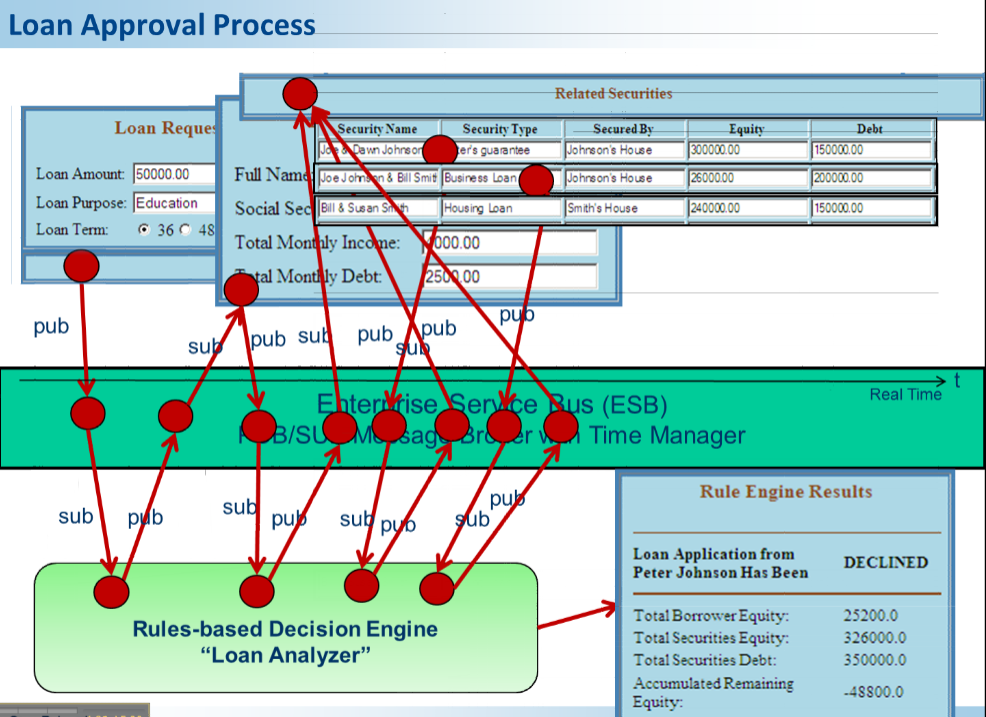
Today ResearchGate confirmed that people continue to read my 2019 presentation “Creating Intelligent Perpetually Running Applications with Business Rules” at the BBC conference. I reread its abstract: “In the AI era, many business applications which consider themselves “intelligent” cannot simply execute a complex rules-based transaction and wait for the next one. To become really “intelligent” applications, they should be able to learn from already executed transactions, accept new facts as they become available, and, when necessary, they should make changes in their own execution logic. This presentation describes a practical architecture that supports the creation and continuing development of such intelligent, perpetually running decision-making applications. This proposed architecture utilizes the modern pub/sub tools with continuous data streams and state machines, allowing subject matter experts to define and maintain behavioral and decisioning rules. It’s been demonstrated by using several real-world scenarios.” Then I went through my presentation with a new interest. If you are also interested in long-running decision services you may read about Stateful Loan Approval and watch Demo of a long-running decision service.

Movie Production Scheduler

This year OpenRules was approached by a film production company that wanted to optimize their movie production scheduling process. They wanted us to build a scheduler that receives the following input: multiple scenes, estimated time to prep and film the scenes, shooting locations, day and night shifts, all characters, cast members with their availability and associated costs, production units, and other related information. The objective of the scheduler is to schedule a production process over a certain period subject to time constraints, actor preferences, location availability, union requirements, and various soft and hard constraints. We’ve successfully and quickly developed a working prototype that satisfied major customer’s requirements and produced good schedules for this particular client. Then we expanded this development to a generic Movie Production Scheduler now available for solving similar scheduling problems with more custom constraints and preferences.

Continue reading

Decision Modeling: Iterating over Collections

OpenRules supports decision tables applied to all element of collections of objects. The phrase [for each <element> in >collection>] added to the end of the decision table signature applies the rules to every <element> of the <collection>. In this post I will explain additional iteration capabilities now available to OpenRules customers.

Continue reading

How decision models deal with fairness

The discussion “Decision Modeling and Fairness” raises very interesting issues, some of which were addressed in the original Guido Tack’s presentation as well in several solutions for Stable Marriage Challenge including OpenRules. In this post I’d like to look at this problem from the perspective of real-world decision-making applications. Do they actually deal with the fairness of the recommended decisions and if yes, then how?

Continue reading

Decision Models for DMCommunity Challenge “Smart Marriages”

This June-2024 Challenge deals with the famous stable marriage problem formulated as follows:

“Given n men and n women, where each person has ranked all members of the opposite sex in order of preference, marry the men and women together such that there are no two people of opposite sex who would both rather have each other than their current partners. When there are no such pairs of people, the set of marriages is deemed stable.”

A very good analysis of the problem is provided in the recent presentation given by Dr. Guido Tack. My solution is based on OpenRules Rule Solver. It includes two different implementation approaches described in this document. The complete decision model has been added to RuleSolver samples.

Continue reading

Lookup Tables

We completed a decision model that provides a solution for DMCommunity April-2024 Challenge “Using Lookup Tables in Decision Models“. This challenge deals with processing complex medical claims containing many medical procedures and diagnoses. The decision model is supposed to find incompatible procedures and diagnoses using large CSV files that may contain hundreds of thousands of records. There were two major requirements:

  1. Maintaining standard lists separately from the decision models
  2. High performance: handling millions of claims per day.

Our decision model demonstrates how to satisfy these requirements while representing the claim processing logic using simple decision tables oriented to business analysts.

Continue reading

Solutions for Challenge “Soldier Payment Rules”

The DMCommunity’s Aug-2023 Challenge brought serious discussions at LinkedIn about the integrated use of SQL and Rule Engines. Instead of making generic statements about which technology is better, I prefer to answer this question for a concrete problem. My colleague Alex Mirtsyn has already provided a pure rules-based solution. As I was asked to provide a solution with OpenRules RuleDB, I extended Alex’s solution with access to a relational database directly from business rules. I will describe the resulting decision model in this post.  

Continue reading

Sanity Checkers for AI-based Decisions

“When it comes to AI, expecting perfection is not only unrealistic, it’s dangerous.
Responsible practitioners of machine learning and  AI always make sure
that there’s a plan in place in case the system produces the wrong output.
It’s a must-have AI safety net that checks the output,
filters it, and determines what to do with it.”
Cassie Kozyrkov, Chief Decision Scientist, Google

“When we attempt to automate complex tasks and build complex systems, we should expect imperfect performance. This is true for traditional complex systems and it’s even more painfully true for AI systems,” – wrote Cassie Kozyrkov. “A good reminder for all spheres in life is to expect mistakes whenever a task is difficult, complicated, or taking place at scale. Humans make mistakes and so do machines.” 

Like many practitioners who applied different decision intelligence technologies to real-world applications, I can confirm the importance of this statement. I also can share how we dealt with the validation of automatically made decisions in different complex decision-making applications.

Continue reading

Generative AI at DecisionCAMP

As the Chair of DecisionCAMP-2023, I published my notes from this major annual decision-management event. This year was dominated by the “huge elephant in our decision modeling kitchen”: Generative AI. Contrary to many other conferences that discuss this explosive technology in general, the Decision Management Community deals with very specific real-world problems and has a well-established standardized infrastructure for their practical solutions. So, we have good ideas where exactly to apply constantly advancing ChatGPT, LLMs, and other Generative AI tools.

Continue reading

DecisionCAMP-2023 starts on Sep 18

DecisionCAMP is the annual gathering devoted to Decision Intelligence technologies that help businesses build Intelligent Decision Services and integrate them into modern enterprise architectures. These technologies bring AI into the hands of business users. With LLM breaking all rules, this year camp will be especially interesting as many speakers will talk about the integrated us of Generative and Symbolic AI. I will again chair this important event and will present “Declarative Decision Modeling with Rule Solver” on Sep 19 at 9:00 AM EDT. Everybody may join the DecisionCAMP by registering for free. Link

Custom Template for Nested Loops

If you read attentively my latest post, you may notice this interesting table:

What does it do? It compares every unique pair (G1;G2) of elements of the array “Guests” using rules “SeatingForTwoGuests”. It is based on the newly introduced custom template “ActionNestedLoops” that our customers may find it quite useful.

Continue reading

Pattern Matching in OpenRules Decision Tables

OpenRules allows non-technical users to easily compare different strings with certain values. Decision table conditions may use simple operators such as “Is”, “Is One Of”, “Starts With”, and “Contains”. There are also more powerful patterns matching operators such as “Like” and “Match”. In this post I will describe these useful operators.

Continue reading

Decision Model “Permit Eligibility”

In this post we describe an OpenRules decision model that addresses DMCommunity.org Mar-2023 Challenge “Permit Eligibility”. The Challenge asks to implement this rule: “An applicant is eligible for a resident permit if the applicant has lived at an address while married and in that time period, they have shared the same address at least 7 of the last 10 years.” There is already 2 DMN-based solutions published by Bruce Silver who explained that this simply sounding rule requires to address several not so simple considerations. There is also an attempt to create a decision model with ChatGPT, which I analyzed and converted to a working Java code. I asked an OpenRules developer Alex Mirtsyn to look at this problem, and together we came up with a solution described in this post.

Continue reading

Happy 20th Birthday, OpenRules!

Happy20

OpenRules, Inc. is now 20 years old! Our team met this anniversary in the best possible way – we did not notice it! We are so busy with adding new powerful capabilities to OpenRules products and supporting our real-world customers. I described a brief history of our company and our development plans 5 years ago. Since then we overperformed by introducing OpenRules Decision Manager which became one of the fastest and user-friendly Decision Intelligence Platform available on the market today. More and more major corporations worldwide choose OpenRules for intelligent business automation. Stay tuned: 20-year-old OpenRules with proven records and unique R&D capabilities is working on new breakthroughs.

OpenRules is Shining in the Serverless World

When 3.5 years ago we introduced a new OpenRules Decision Manager, it was specifically designed as a Decision Intelligence Framework for creation, debugging, and management of Superfast Decision Microservices for that time brand new Serverless world. Over the last 3 years we witnessed how major corporate customers migrated their rules-based applications deployed on the large web servers to OpenRules. Over the last few weeks we saw how several new customers were really surprised that they don’t need anymore heavy lifting for building and managing their rules-based light-weighted microservices. In this brief post I share a working sample that demonstrates how easy it is to build, test, debug, deploy, and run RESTful decision services with OpenRules using any on-cloud or on-premise infrastructure.

Continue reading

OpenRules 9.1.0 with Friendly Iterations

OpenRules Release 9.1.0 essentially simplifies how our customers iterate over collections of business objects. Now you may describe your loops in one decision table, immediately see iteration nodes in Decision Diagrams, and analyze the content of each iteration while you are looping over collections inside OpenRules Debugger. Here is a simple loop over an array of Players that accumulates their scores to calculate Team Score:

If in the previous releases every iteration required at least two tables, in Release 9.1.0 one intuitive table is sufficient.

Continue reading

New Major Release OpenRules-9: Happy Thanksgiving!

Our team worked hard to prepare a nice Thanksgiving gift for our customers, and today I am happy to announce general availability of OpenRules-9! This major new release comes with a new implementation of our Graphical Explorer and Debugger as a foundation for the current and future OpenRules Interactive Decision Modeling Environment oriented to business users. Watch new Intro Video, read Release Notes 9.0.0, and evaluate it for free. Happy Thanksgiving!

Continue reading

Business Rules and SQL: Competitors or Partners?

IEEE Spectrum just published the article “The Rise of SQL” about the recent SQL’s comeback caused not only by the ever-increasing use of databases, but also by the use of SQL within the fields of data science, machine learning, big data, and streaming systems. While traditionally, Business Rule Engines did not communicate with databases directly, our customers frequently prefer to use SQL-like business rules to access their data when it is necessary following their business logic. At the same time, they want to preserve the power of SQL dealing with databases of any complexity. Two years ago OpenRules introduced a special product “Rule DB” that does exactly this by empowering Excel-based business rules with a run-time RDBMS communication mechanism. In this post we will explain how to migrate an SQL query to OpenRules.

Continue reading

Decision Models for Medical Claim Processing

DMCommunity.org Challenge May-2022 still has no submitted solutions. I knew that the problem is not as simple as it sounds because we, at OpenRules, have quite a few claim processing customers, whose decision models address similar and much more difficult problems. When I tried to create a decision model for this challenge, I quickly got a solution that still produced these errors while processing a test-claim:

[E71.313] cannot be reported together with [E72.3]
[E72.3] cannot be reported together with [E71.313]

But the challenge specifically required not to produce duplicate errors. Trying several decision modeling approaches, I built a few “tried-and-failed” decision models before I came up with two solutions which I feel comfortable enough to share here.

Continue reading

Decision Services Handling Large Payloads

On Apr 20, 2022 I shared recent OpenRules experience building decision services capable to handle huge payloads with sound performance. He described how putting a decision service into a cloud-based environment supporting parallel execution allowed a large US corporation improve the performance 100 times! Watch Recording

OpenRules Debuggers

OpenRules Decision Manager provides two Decision Model Debuggers:

While the graphical debugger is the most user friendly debugger, it is currently available only under Windows and Linux. The Command Line Debugger is available under Windows, Mac, and Linux. Continue reading

RESTful Decision Services: Error Handling with OpenRules

Usually input validation is an essential part of business decision models created by OpenRules customers. They add rules that validate input decision variables for null values, empty strings, impossible values like Feb 29 during a non-leap year, and many other problem-specific input errors. These custom error reporting mechanisms usually generate lists of errors with explanations in the JSON response for RESTful decision services. However, while input errors are diagnosed by the decision service, its return code is usually 200 meaning it was a “good” request. In this post I will describe how your service may return code 400 for bad requests.

Continue reading

Mitigating Log4J Security Vulnerability

On December 12, 2021 Apache Log4J 2.x reported that this widely used Java logging framework has been exposed to a serious security vulnerability. OpenRules Decision Manager like many other Java-based products uses Log4J. To mitigate this problem, we quickly switched to the recommended version 2.15.0 of log4j that was supposed to remove the above vulnerability. However, on December 14 the second vulnerability was discovered and Apache released the version 2.16.0 to address the problem.

Based on the seriousness of these events, we decided to create a new emergency release 8.4.3 of OpenRules Decision Manager that uses log4j version 2.16.0 (not 2.15.0). We’ve already built the first version 8.4.3 and it’s going through thorough testing. For urgent situations we made the evaluation version 8.4.3 available from here. Our team will continue to work hard to make sure that well-tested Release 8.4.3 will be available to all customers tomorrow morning. If you have any questions, please contact support@openrules.com.

Advancing AWS Lambda Decision Services

AWS Lambda has recently extended the capability to track the current state of a function through its lifecycle. In this post AWS wrote: “We’re extending the General Update from September 30 2021 to December 5 2021. The End of Delayed Update date is now also changed to December 6 2021.” With this change, all users of AWS Lambda need to update their AWS SDK-based automation workflows. How would it affect OpenRules-based decision services deployed as AWS Lambdas?

Continue reading

Decision Services: Free POC Development

OpenRules Decision Manager becomes so powerful and easy to use that it dramatically reduces the efforts needed to develop new decision models and deploy them on cloud as decision microservices. Usually everything is done in Excel with our graphical Explorer without any coding. Along with development of large decision-making applications, our team has great practical experience of rapid creation of working prototypes or Proof of Concepts (POC). After a brief meeting with a customer, we quickly (usually within 1-3 days!) put together a POC tested locally and deployed on cloud, so the customer may start testing it remotely without any installations! Continue reading

OpenRules Release 8.4.2 improves Validation and Consistency Checking of Rule Repositories

Our customers will appreciate the new OpenRules Release 8.4.2 as it essentially improves the validation and consistency checking of their Rule Repositories. It provides much better error diagnostics in business friendly terms. In the Release 8.4.2 we actually implemented a new built-in compiler that runs during the BUILD phase (build.bat), so the majority of errors can be caught before Java code generation. We also added an ability to use CSV-files in situations when XLS-files are too big/slow to handle. We removed Maven Wrapper from all samples and made a free Apache Maven a pre-requisite. Release Notes

When to use Machine Learning, Optimization, and/or Business Rule Engines

Last week I listened the webinar “The Art of Knowing How to Leverage Decision Intelligence” presented by Roy Schulte, Distinguished VP Analyst at Gartner. Describing the major trends in decision intelligence and why it is growing, Roy concentrated on the question “when to use machine learning, optimization or business rule engines”:

Continue reading

Using CSV Files in OpenRules

When it comes to handling large collections of data in business rules, OpenRules customers frequently use Excel-based DecisionData tables and/or decision tables of the type “BigTable“. It works fine when Excel tables contain thousands or even tens of thousands rows. However, when an Excel file contains hundreds of thousands rows Excel itself becomes much slower to search and requires much more time and memory to be downloaded in OpenRules. In this case we recommend our customers to switch from the Excel to the CSV format.

Continue reading

Using DecisionData Tables in OpenRules

OpenRules Decision Manager provides all necessary tools to build, test, and debug your business decision models. The same people (subject matter experts) who created decision models can create test cases for these models using simple Excel tables or objects coming from the outside world (from Java, XML, or JSON). This post explains how to create and use test cases and data tables.

Continue reading

Continuous Digital Decisioning

Modern enterprises quickly evolved from monolithic to microservices architectures and they naturally expect that rules-based decision services to be good citizens of the new CI/CD world. My DecisionCAMP-2021 presentation https://lnkd.in/g_rWAazF shares OpenRules experience of developing, integrating, and deploying operational decision microservices which satisfy the requirements of modern enterprise architectures including security, continuous integration and delivery/deployment. Using specific examples, it explains how business analysts may represent and maintain these requirements in their business decision models.
Keywords: Business Decision Models, Decision Microservice, Invocation Context, Authorized access, Security, CI/CD Watch

Titanic Booking Service

This is the name of the DMCommunity.org Aug-2021 Challenge that is supposed to predict survivors of the Titanic tragedy based on partially known actual results. Dr. Bob Moore has already submitted a very good analysis of this challenge and applied several ML-based approaches to solve it. It inspired me to ponder the same challenge from a bit different angle. I thought I could try two approaches: 1) using common sense or human prejudice-based rules to predict who could survive; 2) using our very simple Rule Learner to let ML algorithms to do the same. I spent almost the whole day today working on this problem, and this post describes what and how I did. It is interesting to compare the final results:

Continue reading

Operational Decision Microservices in the CI/CD World

On Sep 14 I will present “Continuous Digital Decisioning or Operational Decision Microservices in the CI/CD World” at DecisionCAMP-2021. In this presentation we plan to share recent OpenRules experience of developing, integrating, and deploying operational decision microservices which satisfy the requirements of modern enterprise architectures including security, continuous integration and delivery/deployment. Here are two key slides:

Continue reading

Securing OpenRules Decision Services

Release 8.4.1 of OpenRules Decision Manager is about “Securing OpenRules Decision Services” – click on this link to see the new tutorial that describes how to secure decision services using JWT Authentication and SSL communication. Release 8.4.1 also provides business users with an additional control over input and output of their decision models allowing them to validate incoming JSON requests and choose which decision variables to exclude from the produced responses. Read Release Notes