Discovering Rules From Examples

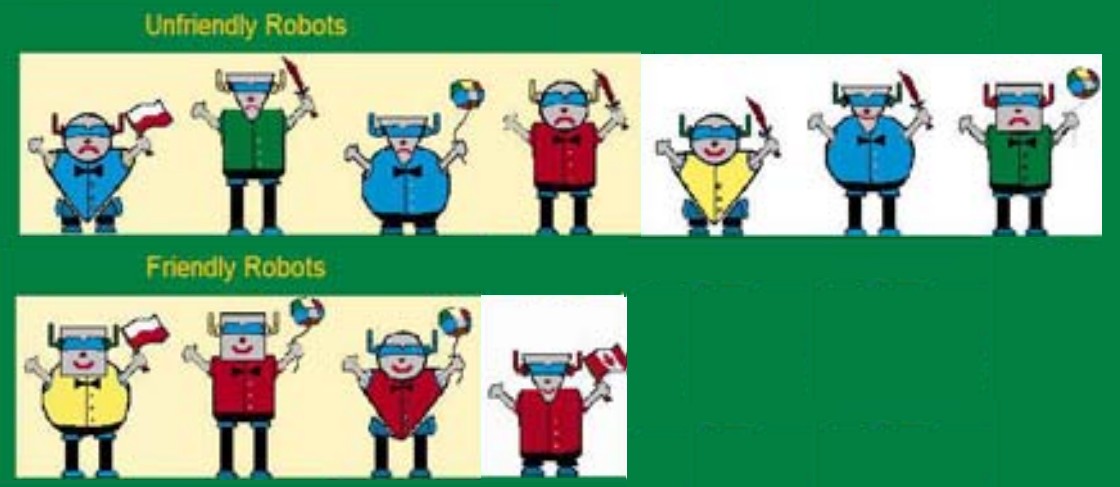
Watch this short Richard Feynman’s video about Discovering Rules of Chess. He used a chess analogy to explain what we are doing in trying to understand nature: “Imagine that the gods are playing some great game like chess. You don’t know the rules of the game, but you are allowed to look at the board at least from time to time from a little corner, perhaps. And from these observations, you try to figure out what the rules of the game are, what are the rules of pieces moving.”

After watching this video, I decided it could be interesting today to refresh several past projects devoted to the Automatic Rules Discovery based on positive and negative examples. I will describe a few projects in which I and/or some of my colleagues were involved.

Continue reading

Decision-Making Systems: Continuing Education

It is interesting to look at the latest Decision Intelligence trends from a 10-year-old perspective when GenAI was not even around. “You don’t program a system, you educate it. Rather than coding into the system, you merely provide a large set of training examples,” – wrote Jean-Francois Puget at that time. Reread my 2015’s post “Don’t Program a System, Educate It!

Machine Learning inside Decision-Making Applications: Practical Use Cases

Machine Learning (ML) tools have been successfully used for decision-making applications for many years. Despite many success stories, ML popularity in enterprise-level software for years remained incomparable with commonly used Rule Engines or even with Optimization tools. Why? Until recently some application developers considered ML to be “too scientific” or unstable with rarely guaranteed results, others complained that it required too much data for practical applications. Nowadays, when Generative AI dominates most technological news and many populists use the terms “AI” and “ML” almost as synonyms, the situation is changing. Vendors and practitioners, who professionally develop decision intelligence software, see a growing interest in ML tools as enterprise developers want to add AI to their existing decision-making applications.

Continue reading

Integrated Use of Rule Learner and Rule Engine

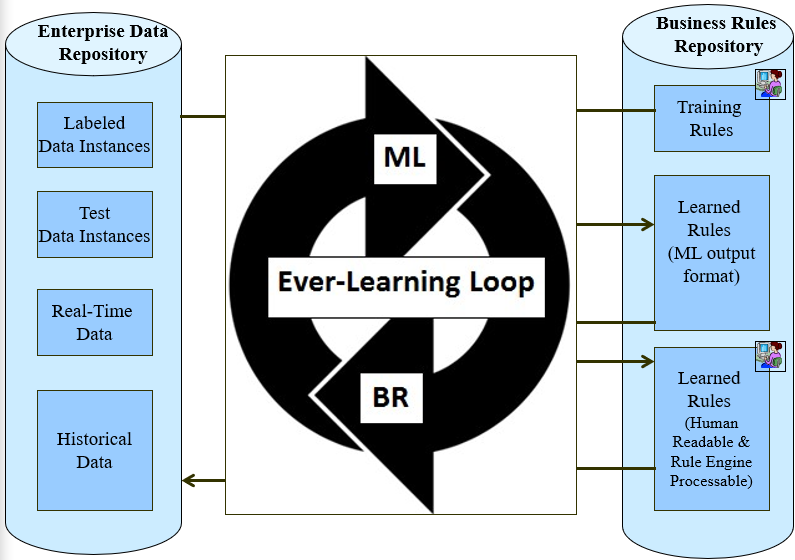
Nowadays we are experiencing an interesting phenomenon: the more people talk about Generative AI, the more interest we see in the integration of Rule Engines and traditional Machine Learning tools such as http://RuleLearner.com. It is especially important when our customers put these tools into the “Ever-Learning Loop” when the Rule Learner constantly learns new rules from the decisions produced by Rule Engine using previously discovered rules. You may use this simple cloud-based service https://saas.rulelearner.com/ to see how easy to learn rules from historical datasets. You will be able to discover classification rules based on your own labeled datasets without any downloads.

Generative AI at DecisionCAMP

As the Chair of DecisionCAMP-2023, I published my notes from this major annual decision-management event. This year was dominated by the “huge elephant in our decision modeling kitchen”: Generative AI. Contrary to many other conferences that discuss this explosive technology in general, the Decision Management Community deals with very specific real-world problems and has a well-established standardized infrastructure for their practical solutions. So, we have good ideas where exactly to apply constantly advancing ChatGPT, LLMs, and other Generative AI tools.

Continue reading

We Know More Than We Can Tell

Living through the ChatGPT boom, it is interesting to read this article “Is ChatGPT Aware?“:

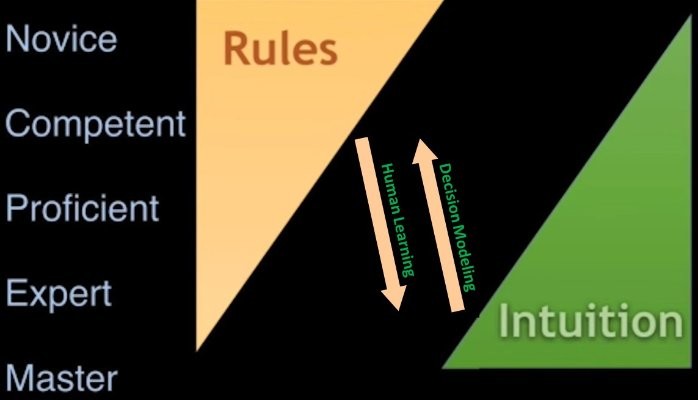
Polanyi’s paradox, named in honor of the philosopher and polymath Michael Polanyi, states that “we know more than we can tell.” He means that most of our knowledge is tacit and cannot be easily formalized with words. In The Tacit Dimension, Polanyi gives the example of recognizing a face without being able to tell what facial features humans use to make such a distinction.

It brings back some of my related thoughts on “Business Rules and Tacit Knowledge” from 7 years ago. It described how “Human Learning” and “Decision Modeling” were moving in opposite directions. Will we see a change?

Rules-based Machine Learning

The integrated use of Rule Engine and Machine Learning (ML) products becomes more and more popular. OpenRules Rule Learner is a good example of such integration. While there are plenty of powerful Machine Learning algorithms available off-the-shelf, it can be quite practical to use rules-based machine learning instead. The classical rules-based technology may address learning problems considering historical and constantly changing operational data. In such situations a “Rule Engine” plays a role of a “Rule Learner”. Here is a good example.

Continue reading

ProcessCon-21

Last week I was on the panel “Hyper Automation and the Convergence of #BPM, #RPA, #Rules, & #iPaaS” of the ProcessCon-21, a User Conference organized by our partner ProcessMaker. Together with leaders from UiPath, SnapLogic, and ProcessMaker we discussed the latest trends in low-cod/no-code development and much more. Watch Video. You may also check out this webinar “Building lightweight composable process applications using rules + workflow

Continue reading

Compressing Decision Tables

The DMC Challenge Sep-2020 deals with compression of decision tables trying to replace relatively large decision tables with “almost” equivalent but smaller decision tables. It is only natural to apply Machine Learning to this problem as it allows us to automatically discover business rules from the sets of labeled historical data records. So, I decided to use the open source Rule Learner to address this problem. In this post I will describe how I approached this problem with these implementation steps:

  1. Write a simple generator of data instances with various combinations of known attributes
  2. Run the existing decision table using OpenRules to produce labeled instances
  3. Feed the labeled instances to Rule Learner (or SaaS Rule Learner) to automatically discover a new decision table and evaluate its performance.

Continue reading

SaaS Rule Learner

No alt text provided for this imageFinally, our SaaS Rule Learner became publicly available allowing business analysts to extract business rules from their historical data sets. They can do it without any downloads directly from Amazon cloud using AWS Marketplace SaaS subscription – see https://aws.amazon.com/marketplace/pp/B08HNF1Q5J. Watch this video https://youtu.be/88B5rJa2yrI that describes how to use it for the demo and custom data sets. Try SaaS Rule Learner from http://saas.rulelearner.com. Continue reading

Self-Learning Decision Models

Today I presented “Rule Learner: Self-Learning Decision Models” at the DecisionCAMP Monthly Meeting. It’s about an integrated use of Machine Learning (ML) and Business Rules (BR) within Digital Decisioning Platforms. It describes how “RuleLearner.com” can help business analysts to discover business rules from large historical data sets. Without forcing business analysts to become experts in data science or programming, Rule Learner discovers business rules by naturally incorporating ML algorithms into Business Decision Models. The session focuses on practical aspects of rules generation by developing ever-learning decision-making applications. Video, Slides

New Rule Learner for Ever-Learning Decision-Making Systems

OpenRules, Inc. was among first BR vendors who introduced the integrated Machine Learning and Business Rules approach back in 2007.  Over the years, our Rule Learner was successfully used to discover business rules by analyzing large sets of historical data in different problem domains. One of the first success came in the large IRS project “The integrated use of BR+ML technologies” – read more.

Today we introduced a new version of Rule Learner publicly available as an open-source product under the terms of the LGPL (it means no restrictions for commercial use!). You can download it for free from RuleLearner.com. It naturally integrates Machine Learning (ML) and Business Rules (BR) techniques by incorporating ML algorithms into rules-based Decision Models. Continue reading

Can ML help with Compression of Large Rulesets?

The integrated use of Machine Learning (ML) and Business Rules (BR) is one of the most practical trends in the development of modern decision-making software. OpenRules is involved in this development for more than 10 years starting with our successful ML+BR projects for IRS. Along with a general purpose Rule Learner, we also provide Rule Compressor, that uses ML to compress large decision tables to smaller ones. This recent presentation explains how it works. Continue reading