Generative AI at DecisionCAMP

As the Chair of DecisionCAMP-2023, I published my notes from this major annual decision-management event. This year was dominated by the “huge elephant in our decision modeling kitchen”: Generative AI. Contrary to many other conferences that discuss this explosive technology in general, the Decision Management Community deals with very specific real-world problems and has a well-established standardized infrastructure for their practical solutions. So, we have good ideas where exactly to apply constantly advancing ChatGPT, LLMs, and other Generative AI tools.

Continue reading

Composite Decision Variables

In real-world decision models, you may want to write business rules that refer to combinations of two or more individual decision variables called composite decision variables. For example, your business concept “Department” may have a decision variable “Manager” of the type “Employee” which is another business concept with such variables as “Name”, “Salary”, “Gender”, etc.

Continue reading

Declarative Decision Model “Flight Rebooking”

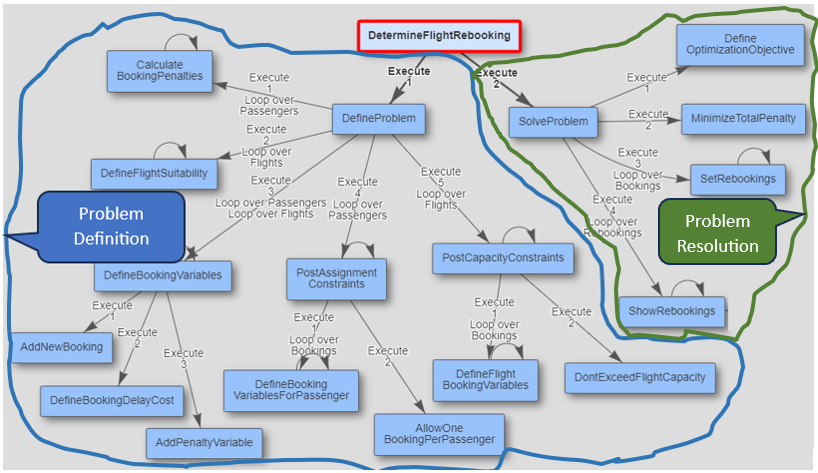
Rule Solver can be used to build a real declarative decision model for one of the most complex decision modeling challenges “Flight Rebooking” offered by DMCommunity.org: “A flight was cancelled, and we need to re-book passengers to other flights considering their frequent flyer status. miles, and seat availability“. Most of the submitted solutions were based on a procedural approach and used different implementations of a greedy algorithm where decision models concentrate on “HOW” to make flight assignments. We suggested and implemented a decision model that concentrate on Problem Definition (“WHAT”) instead of Problem Resolution. The complete model is described here. Link

Unconscious Thoughts

Today Yann LeGun tweeted: “Thought != Language” in response to this Einstein’s quote: “I rarely think in words at all. A thought comes, and I may try to express it in words afterwards.”

It reminded me Henri Poincaré whose book on how the inventor’s mind works I was lucky to read as a University student. I tried to google the topic and found this article: “Poincaré found that he would often struggle unsuccessfully with some mathematical problem, perhaps over days or weeks (to be fair, the problems he got stuck on were difficult, to say the least). Then, while not actually working on the problem at all, a possible solution would pop into his mind. And when he later checked carefully, the solution would almost always turn out to be correct.

How was this possible? Poincaré’s own suspicion was that his unconscious mind was churning through possible approaches to the problem “in the background”—and when an approach seemed aesthetically “right,” it might burst through into consciousness. Poincaré believed that this “unconscious thought” process was carried out by what might almost be a second self, prepared and energized by periods of conscious work, yet able to work away on the problem in hand entirely below the level of conscious awareness. Link
Happy 20th Birthday, OpenRules!

Happy20

OpenRules, Inc. is now 20 years old! Our team met this anniversary in the best possible way – we did not notice it! We are so busy with adding new powerful capabilities to OpenRules products and supporting our real-world customers. I described a brief history of our company and our development plans 5 years ago. Since then we overperformed by introducing OpenRules Decision Manager which became one of the fastest and user-friendly Decision Intelligence Platform available on the market today. More and more major corporations worldwide choose OpenRules for intelligent business automation. Stay tuned: 20-year-old OpenRules with proven records and unique R&D capabilities is working on new breakthroughs.

We Know More Than We Can Tell

Living through the ChatGPT boom, it is interesting to read this article “Is ChatGPT Aware?“:

Polanyi’s paradox, named in honor of the philosopher and polymath Michael Polanyi, states that “we know more than we can tell.” He means that most of our knowledge is tacit and cannot be easily formalized with words. In The Tacit Dimension, Polanyi gives the example of recognizing a face without being able to tell what facial features humans use to make such a distinction.

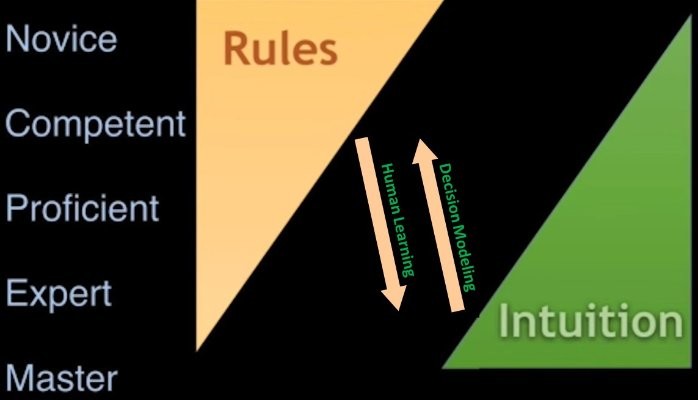
It brings back some of my related thoughts on “Business Rules and Tacit Knowledge” from 7 years ago. It described how “Human Learning” and “Decision Modeling” were moving in opposite directions. Will we see a change?

Decision Modeling: Declarative vs Procedural

The ultimate objective of Business Decision Modeling:

A business analyst (subject matter expert) defines a business problem, and a smart decision engine solves the problem by finding the best possible decision.

Declarative decision modeling assumes that a business user specifies WHAT TO DO and a decision engine figures out HOW TO DO it. This is quite opposite to the Procedural approach frequently used in traditional programming.

Continue reading

ProcessCon-21

Last week I was on the panel “Hyper Automation and the Convergence of #BPM, #RPA, #Rules, & #iPaaS” of the ProcessCon-21, a User Conference organized by our partner ProcessMaker. Together with leaders from UiPath, SnapLogic, and ProcessMaker we discussed the latest trends in low-cod/no-code development and much more. Watch Video. You may also check out this webinar “Building lightweight composable process applications using rules + workflow

Continue reading

Compressing Decision Tables

The DMC Challenge Sep-2020 deals with compression of decision tables trying to replace relatively large decision tables with “almost” equivalent but smaller decision tables. It is only natural to apply Machine Learning to this problem as it allows us to automatically discover business rules from the sets of labeled historical data records. So, I decided to use the open source Rule Learner to address this problem. In this post I will describe how I approached this problem with these implementation steps:

  1. Write a simple generator of data instances with various combinations of known attributes
  2. Run the existing decision table using OpenRules to produce labeled instances
  3. Feed the labeled instances to Rule Learner (or SaaS Rule Learner) to automatically discover a new decision table and evaluate its performance.

Continue reading

Integrated Use of Rule Engines and Constraint/Linear Solvers

Operational business problems can be defined by a set of decision variables and a set of rules that specify relationships between these variables – see the formal definition. This definition considers a decision as a solution of such a problem, but it doesn’t assume anything about ‘HOW’ how decisions will be produced. It means decisions can be found by applying any rule engine, a DMN engine, a constraint or MIP solver, a custom piece of software written in any programming language, a manually provided expert’s decision, or their various combinations. Continue reading

Building Decision Models for DMCommunity.org Challenge “Balanced Assignment”

DMCommunity Sep-2018 Challenge “Balanced Assignment” gives an example of a complex business problem with a serious optimization component. This problem deals with the assignment of people to different project groups. Usually, such problems require deep knowledge of optimization techniques. My interest was to build a decision model for this problem and to investigate what can be done by business people and where the involvement of optimization experts is necessary. So, I attempted to use a business-friendly approach to represent and to solve this complex problem. It was not a simple journey, and this article describes what I did successfully and where I failed. Link

“Model-based” vs. “Method-based” Approaches to Decision Modeling

In Aug-2018 Prof. Robert Fourer gave a tutorial “Model-based Optimization“, in which he compares two essentially different approaches to modeling optimization problem: “model-based” vs. “method-based”. He is using a relatively complex “Balanced Assignment” problem to demonstrate his points. While Fourer’s tutorial deals with optimization, I believe the same arguments are directly related to Decision Modeling that so far mainly remains method-based. During DecisionCAMP-2018 we had interesting (and sometimes hot) discussions about these two approaches and in my closing remarks I described the major differences between them as follows: Continue reading

Decision Management and Semantic Reasoning

Considering the upcoming conferences, I was asked by Harold Boley to write about a possible integration of Semantic Reasoning and Business Decision Management. Today I posted an article at the RuleML Blog and decided to reproduce it here as well but in a bit more friendly format.
On September-2018 DecisionCAMP and RuleML+RR will be co-located again for the third time during the LuxLogAI-2018 summit in Luxembourg. These two events represent different but closely related fields of the knowledge representation movement: Business Rules & Decisions Management and Semantic Reasoning. In this post I want to talk about relationships between these two fields and events.

Continue reading

Happy 15th Birthday, OpenRules!

Today is exactly 15 years since OpenRules, Inc. was incorporated on Feb. 24, 2003. It’s a quite serious milestone, so I decided to write a few words for this occasion. A year ago, I described a brief history of our company and key factors that made it successful. 2018 was an extremely successful year for OpenRules as well: we improved the product and many major corporations became our new customers. But in this post I want to look to the future and to share some of our upcoming and long term plans. Continue reading