
See how OpenRules Decision Playground can help to make a preferred burger using different ingredients while minimizing the total fat, calories, or cost: https://openrulesdecisionmanager.com/decision-playground-make-a-good-burger/
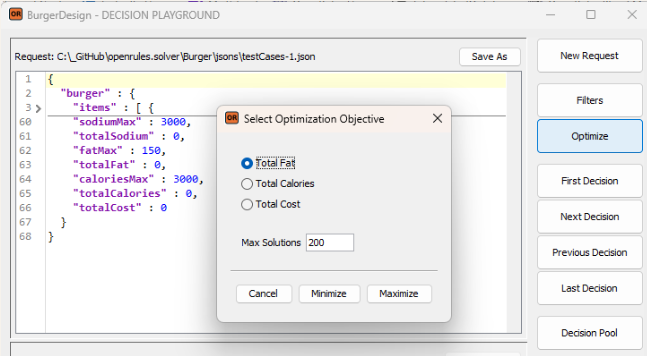
See how OpenRules Decision Playground can help to make a preferred burger using different ingredients while minimizing the total fat, calories, or cost: https://openrulesdecisionmanager.com/decision-playground-make-a-good-burger/

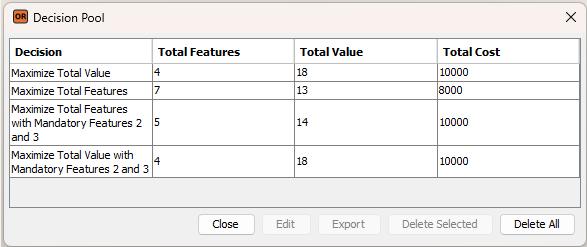
See how OpenRules Decision Playground can help a freelance web designer to choose different combinations of features while maximizing the total value of these features subject to a limited budget: https://openrulesdecisionmanager.com/decision-playground-website-features/

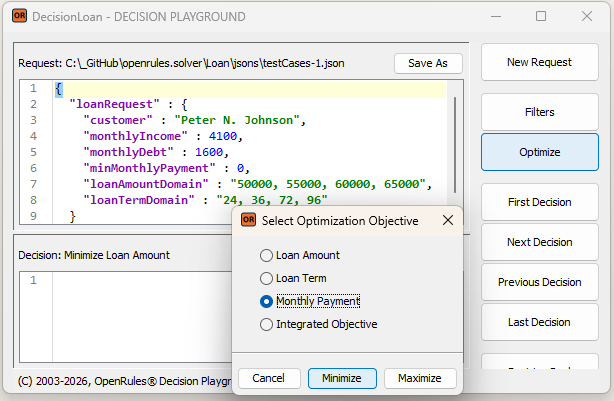
See how OpenRules Decision Playground can serve as a self-service graphical interface that helps the customer select the most appropriate loan conditions: https://openrulesdecisionmanager.com/graphical-decision-modeling/decision-playground/selecting-loan/
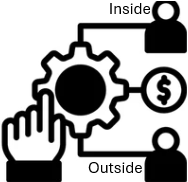
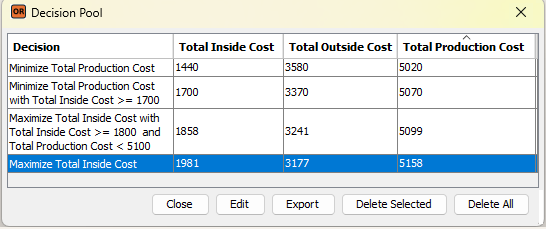
See how OpenRules Decision Playground can help a manufacturer evaluate various production decisions and select the most suitable ones — taking into account long-term resource availability and uncertain future demand. https://openrulesdecisionmanager.com/decision-playground-inside-outside-production/
In this post, I describe a solution to the DMCommunity May 2025 Challenge and briefly analyze different approaches to rules with exceptions and conflicts.
Continue reading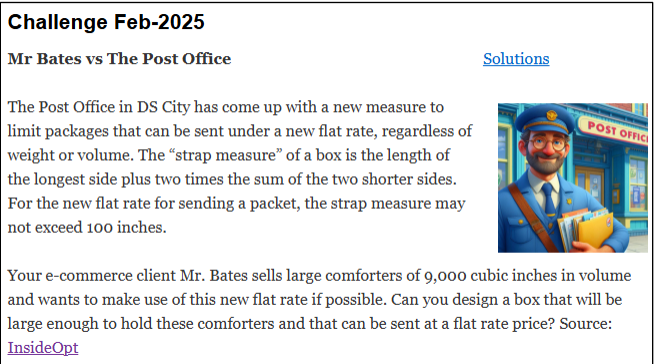
DMCommunity.org posted the challenge “Mr Bates vs The Post Office”. I applied Rule Solver to demonstrate how to solve this challenge using several decision tables. Link
Then I decided to ask GenAI to produce a solution for this challenge using JavaSolver API. I was a bit surprised that Copilot is quite familiar with JavaSolver It quickly generated for me a Java program for a simple Arithmetic problem similar to this one. Then I gave the text of this Challenge in plain English, and Copilot generated a very good working solution for this challenge as well! Here it is: https://dmcommunity.org/wp-content/uploads/2025/03/challenge2025feb.copilot.pdf

OpenRules Rule Solver is an open-source tool that adds the power of Constraint and Linear Programming to Business Decision Modeling. It extends OpenRules Decision Manager to support Declarative Decision Modeling and Decision Optimization.
You may look at multiple decision models from Simple Arithmetic Problems to Smart Investments to see how Rule Solver helps define business optimization problems and produce their optimal solutions. One such decision model was created by our intern to ponder the DMCommunlity Challenge “Rental Boats“.
Continue reading
We introduced RuleScheduler on Sep 19, 2024 at DecisionCAMP-2024 as a new OpenRules component for building decision models for Scheduling and Resource Allocation problems. Such problems traditionally considered very complex and they are usually out of reach for most rule engines. Traditionally, these problems require constraint programming tools and the involvement of technical gurus. RuleScheduler intends to allow business analysts to represent and solve these problems without programming by extending traditional user-friendly decision tables.
Continue reading
Machine Learning (ML) tools have been successfully used for decision-making applications for many years. Despite many success stories, ML popularity in enterprise-level software for years remained incomparable with commonly used Rule Engines or even with Optimization tools. Why? Until recently some application developers considered ML to be “too scientific” or unstable with rarely guaranteed results, others complained that it required too much data for practical applications. Nowadays, when Generative AI dominates most technological news and many populists use the terms “AI” and “ML” almost as synonyms, the situation is changing. Vendors and practitioners, who professionally develop decision intelligence software, see a growing interest in ML tools as enterprise developers want to add AI to their existing decision-making applications.
Continue readingOpenRules RuleSolver is an open source tool that adds the power of Constraint and Linear Programming to Business Decision Modeling. It extends OpenRules Decision Manager to support Declarative Decision Modeling and Decision Optimization.
The newest OpenRules Release 10.1.0 comes with an essentially simplified RuleSolver which now requires only two tables “DefineVariables” and “PostConstraints“ to define many complex logical problems. It also provides predefined methods for problem resolution so you really may concentrate only on the question “WHAT” and not worry about “HOW”. I will demonstrate the new decision modeling facilities using a relatively complex logical problem “Family Riddle“.
Continue reading“When it comes to AI, expecting perfection is not only unrealistic, it’s dangerous.
Responsible practitioners of machine learning and AI always make sure
that there’s a plan in place in case the system produces the wrong output.
It’s a must-have AI safety net that checks the output,
filters it, and determines what to do with it.”
Cassie Kozyrkov, Chief Decision Scientist, Google
“When we attempt to automate complex tasks and build complex systems, we should expect imperfect performance. This is true for traditional complex systems and it’s even more painfully true for AI systems,” – wrote Cassie Kozyrkov. “A good reminder for all spheres in life is to expect mistakes whenever a task is difficult, complicated, or taking place at scale. Humans make mistakes and so do machines.”
Like many practitioners who applied different decision intelligence technologies to real-world applications, I can confirm the importance of this statement. I also can share how we dealt with the validation of automatically made decisions in different complex decision-making applications.
Continue readingThis weekend I tried to play with the latest DMCommunity Challenge that asks: “Suppose you need to pay 1 Euro. In how many different ways you can do it via 1c, 2c, 5c, 10c, 20c, 50c and 1 Euro coins?” It sounds as a very simple problem for any constraint solver.
Continue reading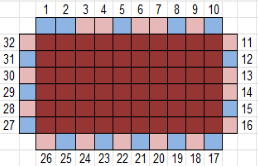
DMCommunity Challenge July-2023 deals with a rules-based decisioning problem when not all rules can be satisfied and thus should be considered as preferences. It offers an advanced version of “Miss Manners” (see OpenRules solution) with not equal numbers of males and females at each party. So, the seating arrangement “boy-girl-boy-girl and each guest has someone on the left or right with a common hobby” becomes not a Rule but a Preference. It makes the problem much more difficult to represent and solve especially if we want to find an optimal seating. In this post I will demonstrate how to build the corresponding business decision model using the latest version of OpenRules Rule Solver.
Continue reading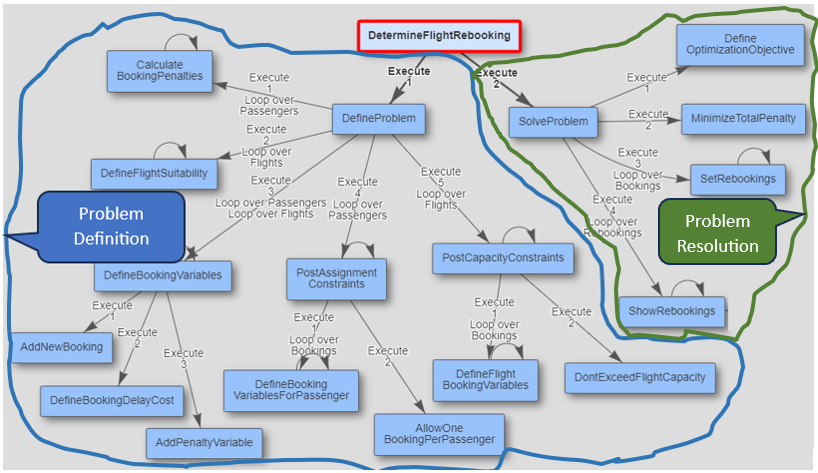
Rule Solver can be used to build a real declarative decision model for one of the most complex decision modeling challenges “Flight Rebooking” offered by DMCommunity.org: “A flight was cancelled, and we need to re-book passengers to other flights considering their frequent flyer status. miles, and seat availability“. Most of the submitted solutions were based on a procedural approach and used different implementations of a greedy algorithm where decision models concentrate on “HOW” to make flight assignments. We suggested and implemented a decision model that concentrate on Problem Definition (“WHAT”) instead of Problem Resolution. The complete model is described here. Link

This problem used to be one of the popular benchmarks for rule engines 20 years ago. And now DMCommunity.org brings it back to see how modern decision engines can represent and solve this problem today. I will demonstrate it in this post with the latest OpenRules Rule Solver.
Continue reading
Everybody is familiar with Sudoku: you need to fill a 9×9 grid in a such way that each column, each row, and each of the nine 3×3 boxes (also called blocks) contains the digits from 1 to 9, only one time each. In this post I’ll show how easy to build a Sudoku decision model using the latest OpenRules Rule Solver.
Continue reading OpenRules - Decision Intelligence Platform