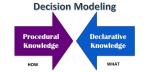
Most experts and practitioners had agreed long ago that decision models should be declarative, meaning a user specifies WHAT the decision problem is and provides test cases with the desired outcome, and then the underlying decision engine or system automatically determines HOW to find the solution. Rule Engines and Constraint Solvers were specifically designed to support the declarativity.
However, in practice, people continue to develop procedural decision models when they explicitly define the step-by-step instructions for reaching a decision. In rules-based systems, their developers rarely use a RETE-based rule engine, preferring to use its sequential counterpart to specify rule execution order (control flow) and algorithms. In constraint-based systems, their developers like to implement problem-specific search heuristics instead of the standard problem resolution algorithms supported by the selected off-the-shelf constraint solver.
I raised this issue many times; here are some examples:
- Decision Modeling: Declarative vs Procedural
- Model-based vs. Method-based Approaches to Decision Modeling.
The latest DMCommunity.org Challenges Oct-2025 (initial) and Nov-2025 (advanced) provide an opportunity to discuss the advantages of declarative decision modeling again. Seven solutions have already been submitted to the initial challenge Oct-2025, and 5 of them use different optimization solvers. I’ve just added two more solutions for the advanced challenge and published an article on LinkedIn that demonstrates the advantages of declarative decision modeling. Link
 OpenRules - Decision Intelligence Platform