
We introduced RuleScheduler on Sep 19, 2024 at DecisionCAMP-2024 as a new OpenRules component for building decision models for Scheduling and Resource Allocation problems. Such problems traditionally considered very complex and they are usually out of reach for most rule engines. Traditionally, these problems require constraint programming tools and the involvement of technical gurus. RuleScheduler intends to allow business analysts to represent and solve these problems without programming by extending traditional user-friendly decision tables.
RuleScheduler allows business users to define and solve a scheduling and resource allocation problem in terms of Activities and Resources as shown below:
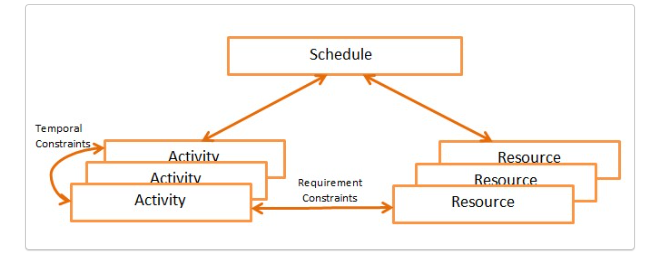
The major business concepts are:
- Schedule is defined in time and has an origin (start) and horizon (end). The Schedule usually consists of activities, resources, and different relationships between them.
- Activities are specified by their starts (usually unknown) and durations. There can be precedence relationships between activities such as “Activity A starts after the end of Activity B”. These relationships are usually called “temporal constraints”.
- Resources usually have limited capacities that may vary over time. For example, people may be available only at certain hours during the day or there could be limited amounts of money in a bank account during different periods. Resources may have different types: RECOVERABLE (like workers) or CONSUMABLE (like money or gasoline). Activities may require or produce different resources, and the proper constraints are usually called “Resource Requirement Constraints”.
You may watch my DecisionCAMP’s presentation Video and Slides that include many simple and more complex examples. RuleScheduler is a component of OpenRules RuleSolver and it becomes automatically available right after RuleSolver’s installation. All sources are included.
 OpenRules - Decision Intelligence Platform