As the Chair of DecisionCAMP-2023, I published my notes from this major annual decision-management event. This year was dominated by the “huge elephant in our decision modeling kitchen”: Generative AI. Contrary to many other conferences that discuss this explosive technology in general, the Decision Management Community deals with very specific real-world problems and has a well-established standardized infrastructure for their practical solutions. So, we have good ideas where exactly to apply constantly advancing ChatGPT, LLMs, and other Generative AI tools.
Decision Management (DM) tools usually used to develop and maintain operational decision services in such areas as Insurance Underwriting, Loan Origination, Risk Management, Fraud Management, Medical Guidelines, Logistics, etc. If we follow an intentionally simplified definition of the DMN standard as “3 shapes and two lines” offered by James Taylor, we may present the decision modeling and execution process as in the following picture:
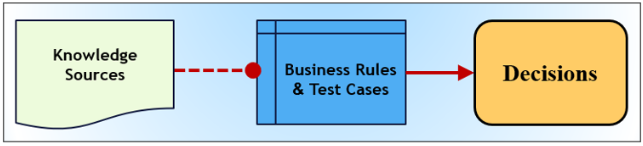
While the second line from “Business Rules” to “Decisions” is well-automated by different DM tools, many presentations with Generative AI in mind concentrated on the first line from “Knowledge Sources” to “Business Rules and Test Cases”. We may expand the above simplified schema with more details:

So, we consider 3 types of Knowledge Sources:
- Expert Knowledge in minds of subject matter experts (SMEs)
- Historical Data available from Excel or CSV file, and from databases
- PDF/Word/Excel Documents and Human Prompts.
Expert knowledge (business logic) in minds of SMEs usually is being converted to Business Rules by SMEs using off-the-shelf Business Rules and Decisions Management tools, and there are many good tools on the market today.
In the last 15 years many of DM practitioners accumulated good experience for how to apply Machine Learning (ML) tools to automatically extract business rules from historical data. The best results have been received when a Rule Learner works inside the “ever-learning loop”:

Here again, we take advantage of the fact that the majority of decision-making applications have a clear separation between Analytical and Operational worlds: the first one is discovering, representing, testing, and constantly updating business logic using business rules while the second one executes rules-based decision services.
And finally, with the quickly advancing Generative AI technology, we may utilize its Natural Language capabilities to automatically generate business rules and test cases based from the trusted sets of documents (in PDF, Word, or Excel formats) and SME’s prompts.
In my Closing Remarks I pointed out that we know exactly where to apply Generative AI tools within our decision Intelligence frameworks:

We also are well aware that to be used in the real-world decision-making applications, these new tools should become good citizens of the modern CI/CD world and support Continuous Decision Modeling, Integration, and Deployment processes. Thus, Decision Management Community by concentrating on very specific real-world problems in different vertical domains from Financial decision services to Health Care guidelines is well-positioned to produce practical results from Generative AI technology. I have no doubts that such practical results will be reported at DecisionCAMP-2024.
 OpenRules - Decision Intelligence Platform