
Unconscious Thoughts

Today Yann LeGun tweeted: “Thought != Language” in response to this Einstein’s quote: “I rarely think in words at all. A thought comes, and I may try to express it in words afterwards.”

It reminded me Henri Poincaré whose book on how the inventor’s mind works I was lucky to read as a University student. I tried to google the topic and found this article: “Poincaré found that he would often struggle unsuccessfully with some mathematical problem, perhaps over days or weeks (to be fair, the problems he got stuck on were difficult, to say the least). Then, while not actually working on the problem at all, a possible solution would pop into his mind. And when he later checked carefully, the solution would almost always turn out to be correct.

How was this possible? Poincaré’s own suspicion was that his unconscious mind was churning through possible approaches to the problem “in the background”—and when an approach seemed aesthetically “right,” it might burst through into consciousness. Poincaré believed that this “unconscious thought” process was carried out by what might almost be a second self, prepared and energized by periods of conscious work, yet able to work away on the problem in hand entirely below the level of conscious awareness. Link

Pattern Matching in OpenRules Decision Tables

OpenRules allows non-technical users to easily compare different strings with certain values. Decision table conditions may use simple operators such as “Is”, “Is One Of”, “Starts With”, and “Contains”. There are also more powerful patterns matching operators such as “Like” and “Match”. In this post I will describe these useful operators.

Continue reading

Nested Attributes in OpenRules Glossary and Tests

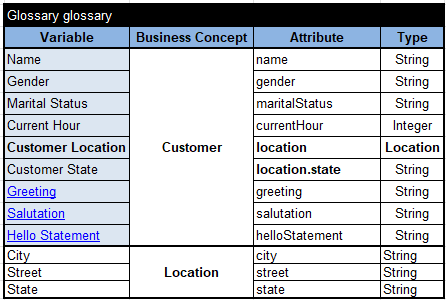
In real-world decision models, our customers deal with complex business glossaries. In particular, it is quite common when one business concept refers to other business concept and it is not immediately clear how to define and use such references. I will explain how it’s supposed to be done in OpenRules. let’s consider a simple example “HelloNestedLocation” with the following glossary:

Continue reading

Nested Loops in OpenRules Decision Models

Iterating over collections (arrays) of decision variables is a frequent need in real-world decision models. For example, the following decision table defines if a company has high-paid employees:

The iteration here is defined by the [for each Employee in Employees] in the first row. The ACTION-BREAK in the column “ActionExecute” will force the iteration process to stop (break) when the very first high-paid employee is found.

Continue reading

Decision Model “Permit Eligibility”

In this post we describe an OpenRules decision model that addresses DMCommunity.org Mar-2023 Challenge “Permit Eligibility”. The Challenge asks to implement this rule: “An applicant is eligible for a resident permit if the applicant has lived at an address while married and in that time period, they have shared the same address at least 7 of the last 10 years.” There is already 2 DMN-based solutions published by Bruce Silver who explained that this simply sounding rule requires to address several not so simple considerations. There is also an attempt to create a decision model with ChatGPT, which I analyzed and converted to a working Java code. I asked an OpenRules developer Alex Mirtsyn to look at this problem, and together we came up with a solution described in this post.

Continue reading

Helping ChatGPT to Build a Working Decision Model

These days only lazy people don’t write about ChatGPT and large language models (LLM). Vendors are trying to be the first to announce a ChatGPT integration even when they don’t have anything serious to show. I’ve also written about it: see “ChatGPT Producing Simple Decision Models and “LLM and Decision Modeling“. This weekend I decided to help ChatGPT (that is now at GPT-4) to address the Challenge “Permit Eligibility” published by DMCommunity.org. It has a simple rule: “An applicant is eligible for a resident permit if the applicant has lived at an address while married and in that time period, they have shared the same address at least 7 of the last 10 years.” But this rule contains several tricky assumptions – no wonder, DM vendors are not in a hurry to submit a solution.

Continue reading

Happy 20th Birthday, OpenRules!

Happy20

OpenRules, Inc. is now 20 years old! Our team met this anniversary in the best possible way – we did not notice it! We are so busy with adding new powerful capabilities to OpenRules products and supporting our real-world customers. I described a brief history of our company and our development plans 5 years ago. Since then we overperformed by introducing OpenRules Decision Manager which became one of the fastest and user-friendly Decision Intelligence Platform available on the market today. More and more major corporations worldwide choose OpenRules for intelligent business automation. Stay tuned: 20-year-old OpenRules with proven records and unique R&D capabilities is working on new breakthroughs.